EOS StainlessSteel SuperDuplex
Material Data Sheet | Powder Product No. 9030-0009
EOS StainlessSteel SuperDuplex
EOS StainlessSteel SuperDuplex is an austenitic-ferritic duplex stainless steel for extreme conditions. The high chromium, molybdenum and nitrogen alloying give excellent corrosion resistance in many difficult environments. The product is optimized for additive manufacturing while maintaining SuperDuplex properties. The optimization of phase balance enables use of the product in as manufactured condition in many use cases. The general pitting resistance equivalent PREN for EOS SuperDuplex is 41 (PREN = %Cr + 3.3 X %Mo + 16 X %N)
- Excellent resistance to uniform, pitting and crevice corrosion
- High strength together with high corrosion resistance
- Oil and gas industry
- Pulp and paper manufacturing devices
- Mining and off-shore equipment
The EOS Quality Triangle
EOS incorporates these TRLs into the following two categories:
- Premium products (TRL 7-9): offer highly validated data, proven capability and reproducible part properties.
- Core products (TRL 3 and 5): enable early customer access to newest technology still under development and are therefore less mature with less data.
All of the data stated in this material data sheet is produced according to EOS Quality Management System and international standards

POWDER PROPERTIES
Powder Chemical Composition (wt.-%)
| Element | Min. | Max. |
|---|---|---|
| Fe | Balance | |
| Cr | 22 | 26 |
| Ni | 9 | 13 |
| Mo | 3 | 6 |
| N | 0.15 | 0.35 |
| C | 0 | 0.03 |
Powder Particle Size
| Generic Particle Size Distribution | 20 - 65 µm | |
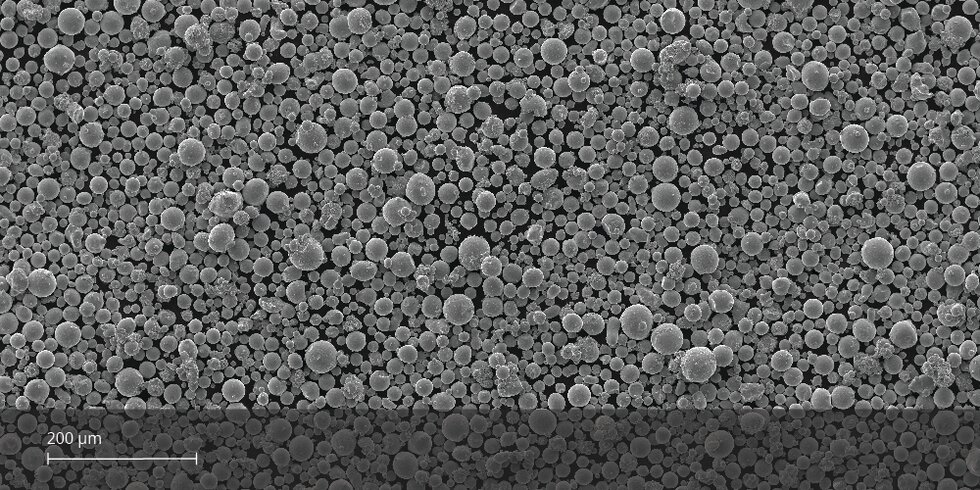
SEM micrograph of EOS StainlessSteel SuperDuplex powder
HEAT TREATMENT
Heat treatment optional.
Solution annealing:
Hold temperature 1100 °C, hold time 0.5 h when thoroughly heated, water quenching
Typical dimensional change after heat treatment -0.4 % (40 µm) or -0.8 % (80 µm)
EOS StainlessSteel SuperDuplex for EOS M 290 | 40/80 µm
EOS M 290 - 40 µm - TRL 3
| System Setup | EOS M 290 |
|---|---|
| EOS Material set | SuperDuplex_040_080_CoreM291_100 |
| Powder Product No. | 9030-0009 |
| Software Requirements |
EOSPRINT 2.9 or newer |
| Recoater Blade | Ceramic |
| Nozzle | EOS Grid Nozzle |
| Inert gas | Argon |
| Sieve | 75 µm µm |
| Additional Information | |
|---|---|
| Layer Thickness | 40 µm, 80 µm, 40/80 µm |
| Volume Rate | 4.1-7.9 mm³/s |
Chemical and Physical Properties of Parts
Chemical composition of built parts is compliant to EOS StainlessSteel SuperDuplex powder chemical composition.
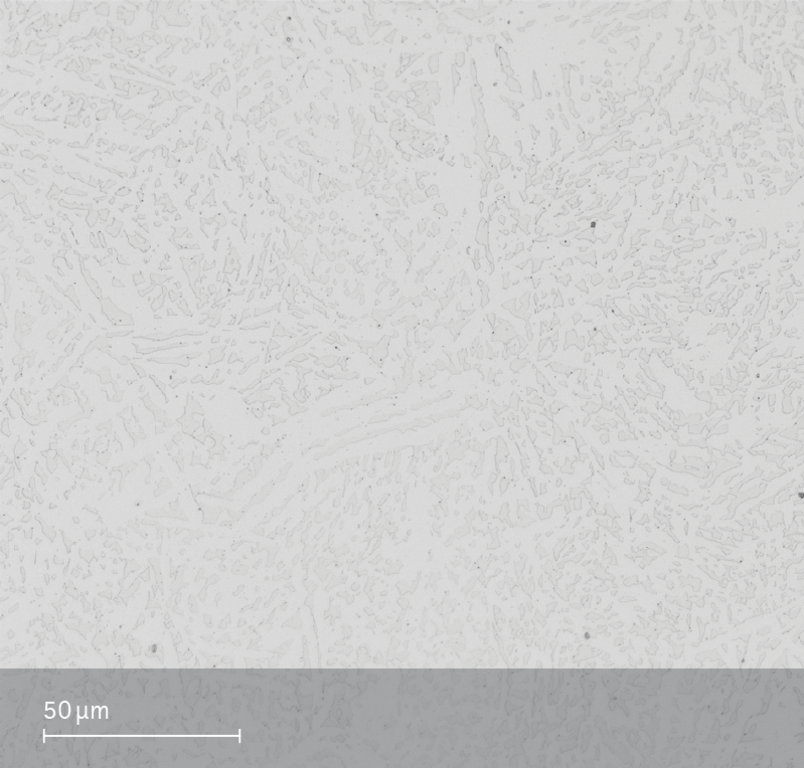
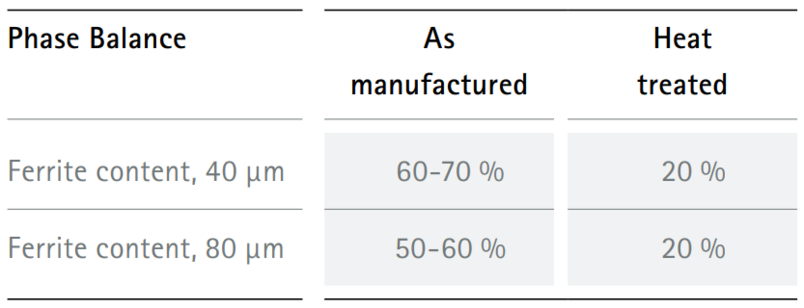
Microstructure of the Produced Parts
| Defects | Thickness | Result | Number of Samples |
|---|---|---|---|
| Average Defect Percentage | 40 µm | 0.04 % | - |
| Average Defect Percentage | 80 µm | 0.08 % | - |
| Density EN ISO 3369 | Thickness | Result | Number of Samples |
|---|---|---|---|
| Average Density | 40 µm | ≥ 7.80 g/cm³ | - |
| Density EN ISO 3369 | Thickness | Result | Number of Samples |
|---|---|---|---|
| Average Density | 80 µm | ≥ 7.80 g/cm³ | - |
Mechanical Properties
Mechanical Properties As Manufactured
| EN ISO 6892-1 Room Temperature | 40 µm | Yield Strength [MPa] | Tensile Strength [MPa] | Elongation at Break A [%] | Reduction of Area Z [%] | Modulus of elasticity [GPa] | Number of Samples |
|---|---|---|---|---|---|---|
| Vertical | 1020 | 1180 | 16 | - | 200 | - |
| Horizontal | 1170 | 1260 | 13 | - | 200 | - |
Mechanical Properties Heat Treated
| EN ISO 6892-1 Room Temperature | 40 µm | Yield Strength [MPa] | Tensile Strength [MPa] | Elongation at Break A [%] | Reduction of Area Z [%] | Modulus of elasticity [GPa] | Number of Samples |
|---|---|---|---|---|---|---|
| Vertical | 560 | 860 | 34 | - | 200 | - |
| Horizontal | 580 | 870 | 34 | - | 200 | - |
Solution annealing
Hold temperature 1 100 °C, hold time 0.5 h when thoroughly heated, water quenching
Typical dimensional change after heat treatment -0.4 % (40 µm) or -0.8 % (80 µm).
Mechanical Properties As Manufactured
| EN ISO 6892-1 Room Temperature | 80 µm | Yield Strength [MPa] | Tensile Strength [MPa] | Elongation at Break A [%] | Reduction of Area Z [%] | Modulus of elasticity [GPa] | Number of Samples |
|---|---|---|---|---|---|---|
| Vertical | 880 | 1050 | 20 | - | 200 | - |
| Horizontal | 1030 | 1130 | 17 | - | 200 | - |
Mechanical Properties Heat Treated
| EN ISO 6892-1 Room Temperature | 80 µm | Yield Strength [MPa] | Tensile Strength [MPa] | Elongation at Break A [%] | Reduction of Area Z [%] | Modulus of elasticity [GPa] | Number of Samples |
|---|---|---|---|---|---|---|
| Vertical | 560 | 860 | 35 | - | 200 | - |
| Horizontal | 570 | 870 | 33 | - | 200 | - |
Modulus of elasticity testing according to EN ISO 6892-1 Method A, Range 1 (0.00007 1/s).
Solution annealing
Hold temperature 1 100 °C, hold time 0.5 h when thoroughly heated, water quenching.
Typical dimensional change after heat treatment -0.4 % (40 µm) or -0.8 % (80 µm).
Impact Toughness
| EN ISO 148-1, Charpy-V As Manufactured | |
|---|---|
| Typical Impact Toughness [J] | 110 |
| Layer Thickness | 40 µm |
| EN ISO 148-1, Charpy-V Heat Treated | |
|---|---|
| Typical Impact Toughness [J] | 155 |
| Layer Thickness | 40 µm |
| EN ISO 148-1, Charpy-V As Manufactured | |
|---|---|
| Typical Impact Toughness [J] | 70 |
| Layer Thickness | 80 µm |
| EN ISO 148-1, Charpy-V Heat Treated | |
|---|---|
| Typical Impact Toughness [J] | 140 |
| Layer Thickness | 80 µm |
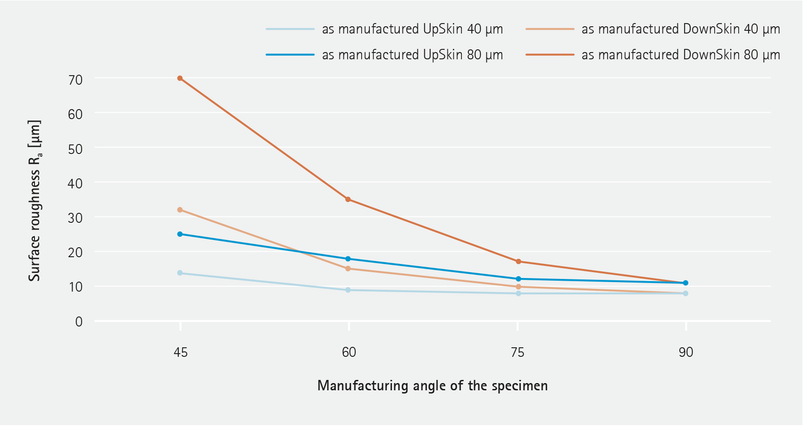
Surface Roughness
| Surface Roughness | From | To |
|---|---|---|
| Sa (µm) | - | - |
| Ra (µm) | - | - |
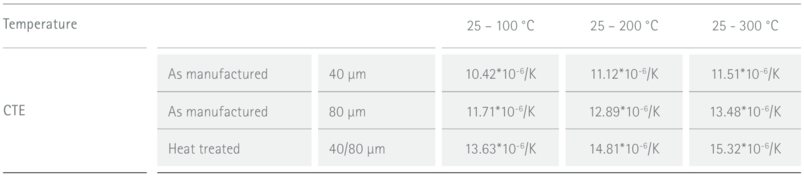
Coefficient of Thermal Expansion