EOS Copper CuCP for EOS M 290 1kW & AMCM M290 1kW | 40 µm
EOS M 290 1kW - 40 µm - TRL 5
Process Information Metal
The EOS Copper CuCP process contains two exposure sets. One exposure set with Technology Readiness Level 5 for general use and bulkier parts and an application specific exposure set targeted for inductors.
| System Setup | EOS M 290 1kW |
|---|---|
| EOS Material set | CuCP_Core040_M294; CuCP_040_M291_1kW |
| Powder Product No. | 9030-0006 |
| Software Requirements |
EOSPRINT 2.15 or newer EOSYSTEM 2.19 or newer |
| Recoater Blade | HSS (High Speed Steel), Carbon Fiber Brush, Silicone |
| Nozzle | EOS Grid Nozzle |
| Inert gas | Argon |
| Sieve | 63 µm |
| Additional Information | |
|---|---|
| Layer Thickness | 40 µm |
| Volume Rate | 5.4 mm³/s |
| Min. Wall Thickness | 0.7 mm |
Chemical and Physical Properties of Parts
Chemical composition of printed parts matches the chemistry of EOS Copper CuCP powder, but can vary due to different oxygen levels in the process, depending on the machine and use level of the powder.
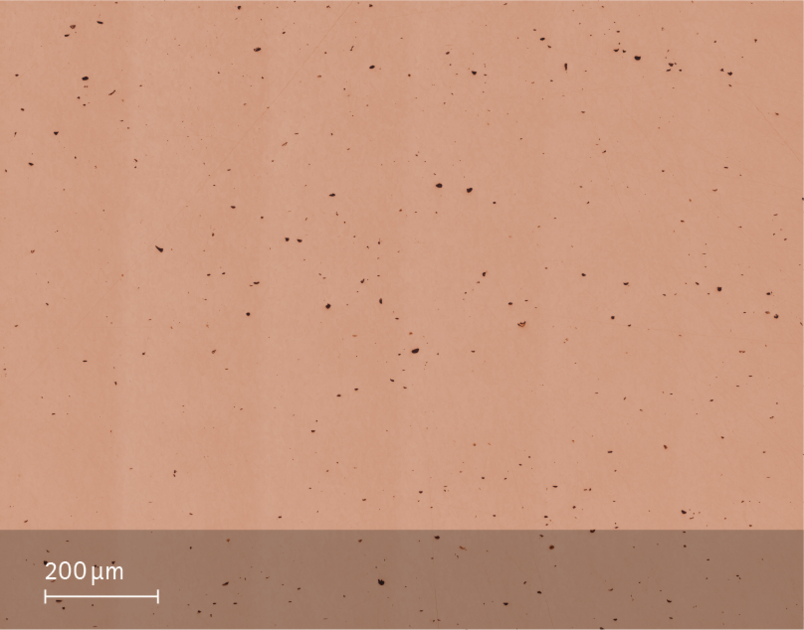
Microstructure of the Produced Parts
| Defects | Thickness | Result | Number of Samples |
|---|---|---|---|
| Average Defect Percentage | 40 µm | 0.4 % | - |
| Density EN ISO 3369 | Thickness | Result | Number of Samples |
|---|---|---|---|
| Average Density | 40 µm | ≥ 8.90 g/cm³ | - |
Mechanical Properties
Mechanical Properties As Manufactured
| EN ISO 6892-1 Room Temperature | 40 µm | Yield Strength [MPa] | Tensile Strength [MPa] | Elongation at Break A [%] | Reduction of Area Z [%] | Modulus of elasticity [GPa] | Number of Samples |
|---|---|---|---|---|---|---|
| Vertical | 160 | 225 | 48 | - | 150 | - |
| Horizontal | 155 | 230 | 45 | - | 150 | - |
Heat treatment of parts built with EOS Copper CuCP is only optional, but can ensure maximum conductivity and uniform structure.
Hold 1 h at ~1 000 °C, slow cooling. Treatment done in heavy argon flow or in vacuum furnace.
Modulus of elasticity testing according to EN ISO 6892-1 Method A, Range 1 (0.00007 1/s).
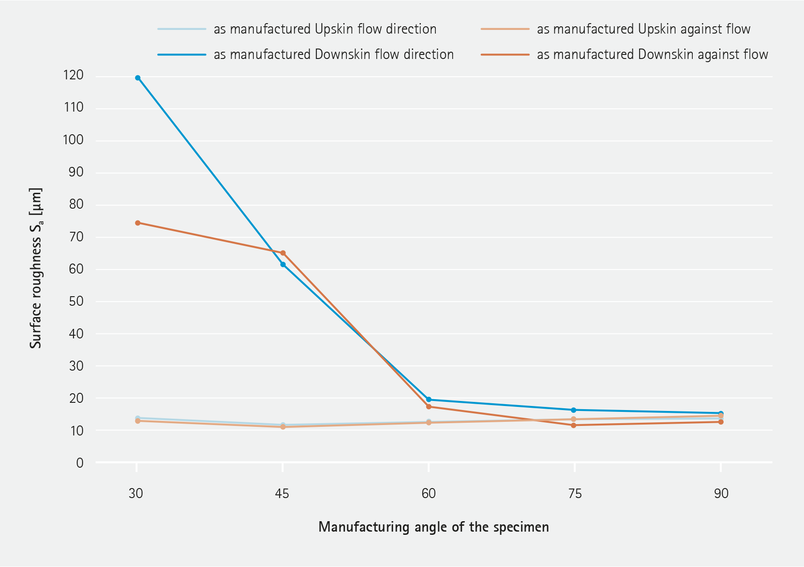
Surface Roughness
| Surface Roughness | From | To |
|---|---|---|
| Sa (µm) | - | - |
| Ra (µm) | - | - |
Effects of Powder Reuse
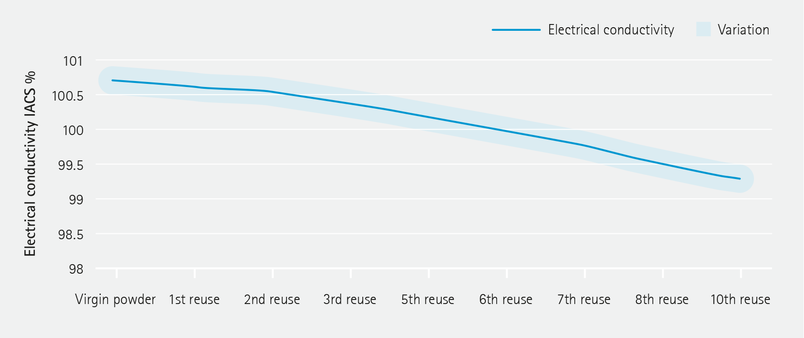
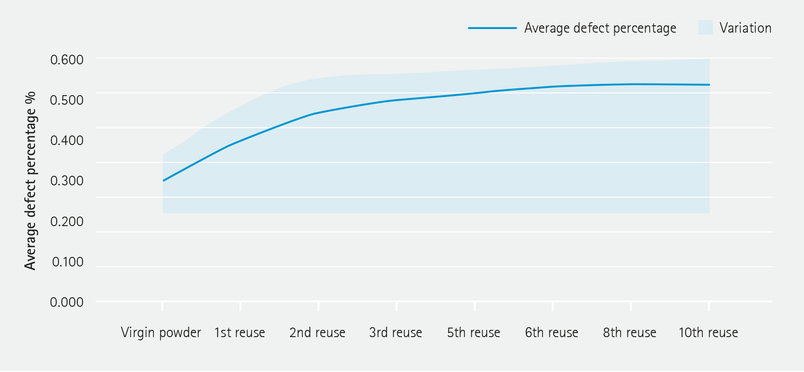
The effects of powder reuse are investigated by running multiple test jobs, until the powder amount was consumed. After every test job, electrical conductivity and porosity were examined, to link powder aging effects to solid part quality.
Electrical conductivity and average defect percentage of parts built with EOS Copper CuCP is depended on the use level of powder and position on the building platform. The electrical conductivity can be maximized by heat treating the final parts.
Left graph: Electrical conductivity IACS% over multiple powder re-uses. The samples were as manufactured and taken from middle of building platform.
There were no measurements after the 4th and 9th reuse. Results may vary over the building platform. Testing according ASTM E1004-17, Eddy Current.
Right graph: Average defect percentage % over multiple powder reuses. The samples were as manufactured and taken from middle of building platform.
There were no measurements after the 4th and 9th reuse. Results may vary over the building platform.
Electrical Conductivity
| ASTM E1004-17 Default | Orientation | Typical Electrical Conductivity [%IACS] |
|---|---|---|
| As Manufactured | 40 µm | Default | Vertical | 100.7 |