
EOS StainlessSteel 17-4PH
Material Data Sheet | Powder Product No. 9011-0041
EOS StainlessSteel 17-4PH
EOS StainlessSteel 17-4PH is a martensitic precipitation hardening stainless steel with high strenght and toughness. EOS 17-4PH corresponds to ASTM A564 (UNS17400, 17-4PH). 17-4PH can be heat treated for use in components with different requirements. It can be widely used in engineering solutions and in components in the medical field.
- High strength
- Good corrosion resistance
- Surgical tools
- Pump components
- Paper mill equipment
The EOS Quality Triangle
EOS incorporates these TRLs into the following two categories:
- Premium products (TRL 7-9): offer highly validated data, proven capability and reproducible part properties.
- Core products (TRL 3 and 5): enable early customer access to newest technology still under development and are therefore less mature with less data.
All of the data stated in this material data sheet is produced according to EOS Quality Management System and international standards

POWDER PROPERTIES
The chemical composition of EOS stainlessSteel 17-4PH is in compliance with ASTM A564.
Powder Chemical Composition (wt.-%)
| Element | Min. | Max. |
|---|---|---|
| Cr | 15 | 17.5 |
| Ni | 3 | 5 |
| Cu | 3 | 5 |
| Si | 0 | 1 |
| Mn | 0 | 1 |
| C | 0 | 0.07 |
| P | 0 | 0.04 |
| S | 0 | 0.03 |
| Nb + Ta | 0.15 | 0.45 |
Powder Particle Size
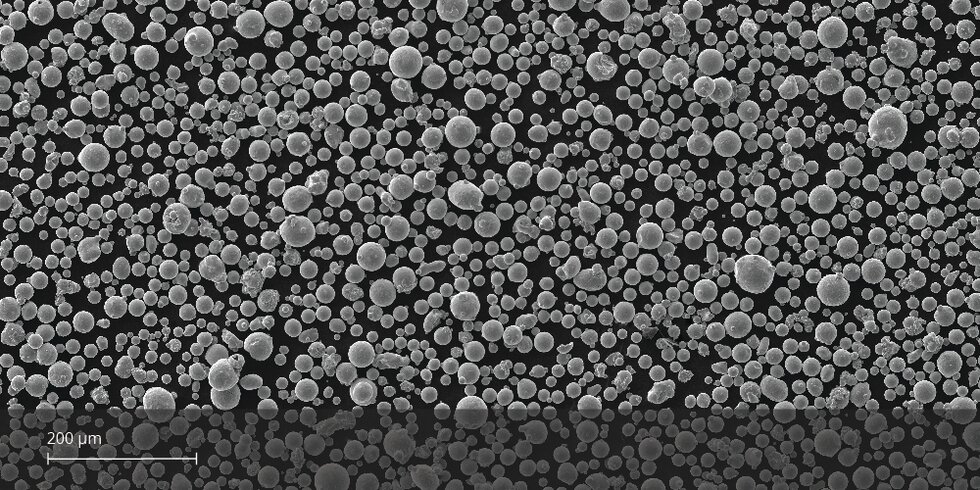
| Generic Particle Size Distribution | 15 - 65 µm | |
HEAT TREATMENT
EOS 17-4PH can be heat treated to match various needs of different applications. The two step heat treatment can be performed under vacuum or inert gas atmosphere. First step is solution annealing to minimize amount of austenite in the martensitic matrix. The needed hardness and strength is achieved through aging treatment where hardening takes place through forming of precipitates.
Solution annealing:
0.5-1 h at 1040 °C (±15 °C) measured from the part followed by rapid air cooling to room temperature (below 32 °C). Cooling rate 5-60 °C/min. Reaching room temperature before starting aging treatment is required to achieve desired microstructure.
Ageing:
Peak hardness of 42 HRC Is achieved with H900 ageing treatment of 1 h at 480 °C (±10 °C) measured from the part followed by air cooling. Mechanical properties presented in this document achieved through this aging procedure. For lower hardness and strength choose aging procedure according to the table.
| Condition | Ageing temperature [°C] | Hold time [h] | Cooling | Hardness [HRC] |
| H900 | 480 | 1 | Air | 42 |
| H925 | 495 | 4 | Air | 38 |
| H1025 | 550 | 4 | Air | 36 |
| H1075 | 580 | 4 | Air | 34 |
| H1100 | 595 | 4 | Air | 32 |
| H1150 | 620 | 4 | Air | 28 |
CYTOTOXICITY
Cytotoxicity tests were done according to ISO 10993-5. It included growth inhibition tests evaluated from two endpoints (XTT & BCA).
Tests were done with as-manufactured cubes. EOS StainlessSteel 17-4PH cubes were extracted under agitation for 24±2h with DMEM 10% FBS. L929 cells were then incubated for 68 – 72h with the following concentrations of the test extract: 13.2%, 19.8%, 29.6%, 44.4%, 66.7% and 100%. Surface/volume ratio used was 3cm2/mL.
In this study under the given conditions no leachable substances were released in cytotoxic concentrations from the test item as confirmed by two different endpoints (XTT, BCA).