
Beyond the Build Chamber: Solukon on Automated Depowdering for AM Production
With Hemank Raj, Process Development Engineer from Solukon
May 13, 2025 | Reading time: 5 min
Additive manufacturing (AM) is increasingly bridging the gap from prototyping to full-scale production, a transition that demands automation and precision at every stage. While the printing process itself often captures the spotlight, post-processing steps like powder removal are critical for achieving high-quality, reliable parts.
In a recent Additive Snack Podcast episode, host Fabian Alefeld sat down with Hemank Raj, an expert from Solukon, to explore the crucial role of automated depowdering in the AM value chain. Their discussion shed light on why this seemingly niche area is, in fact, a cornerstone for scaling AM, particularly for complex applications in demanding
industries.
From Market Pull to Automated Solutions: The Solukon Story
Solukon's journey into automated depowdering began not as a speculative venture, but as a direct response to a market need.
Hemank Raj explained that Solukon, initially an engineering consultancy founded by Andreas Hartmann and Dominik Schmidt — both with decades of experience in machine building and 3D printing — was approached by a renowned German automobile manufacturer. This automotive giant, an early adopter of large-format 3D printers, was facing significant challenges in depowdering large and complex parts.
They developed the first automated solution, which was met with such success and customer delight that word quickly spread, leading to more orders from various industries.
The Automated Depowdering Process: Safety, Repeatability, and Efficiency
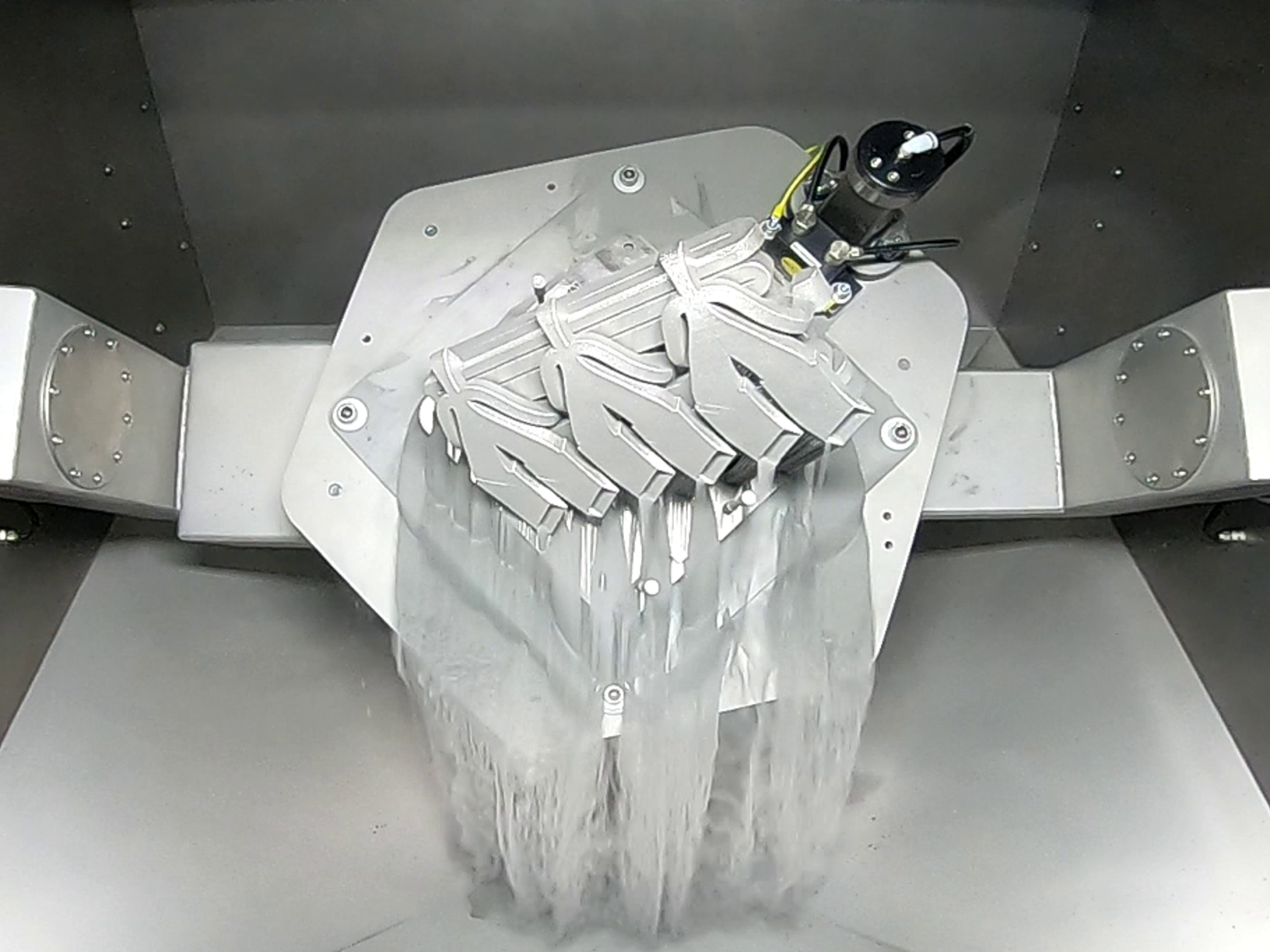
The core of Solukon's offering is a "fully hands-off" automated depowdering process. This involves removing unfused powder from 3D printed parts without manual intervention, all within a sealed, atmospherically controlled chamber. Depending on the material, this chamber is filled with an inert gas like nitrogen (for aluminum) or argon (for titanium) to ensure safety. Using programmable rotation and vibration, Solukon systems ensure thorough and consistent powder removal.
Raj emphasized two key advantages over manual or semi-automated methods:
- Enhanced safety: Eliminating operator exposure to potentially hazardous metal dust.
- Reliable and repeatable processes: Ensuring parts are cleaned to the same standard every time.
Previously, depowdering complex parts with internal channels often involved external vibrators in open environments, posing health risks and taking considerable time, or using hand-blasting chambers where operators manually directed air into channels. These methods lacked the safety, consistency, and efficiency of automated solutions, especially for large, heavy, or intricately channeled components.
Applications Benefiting Most from Automated Depowdering
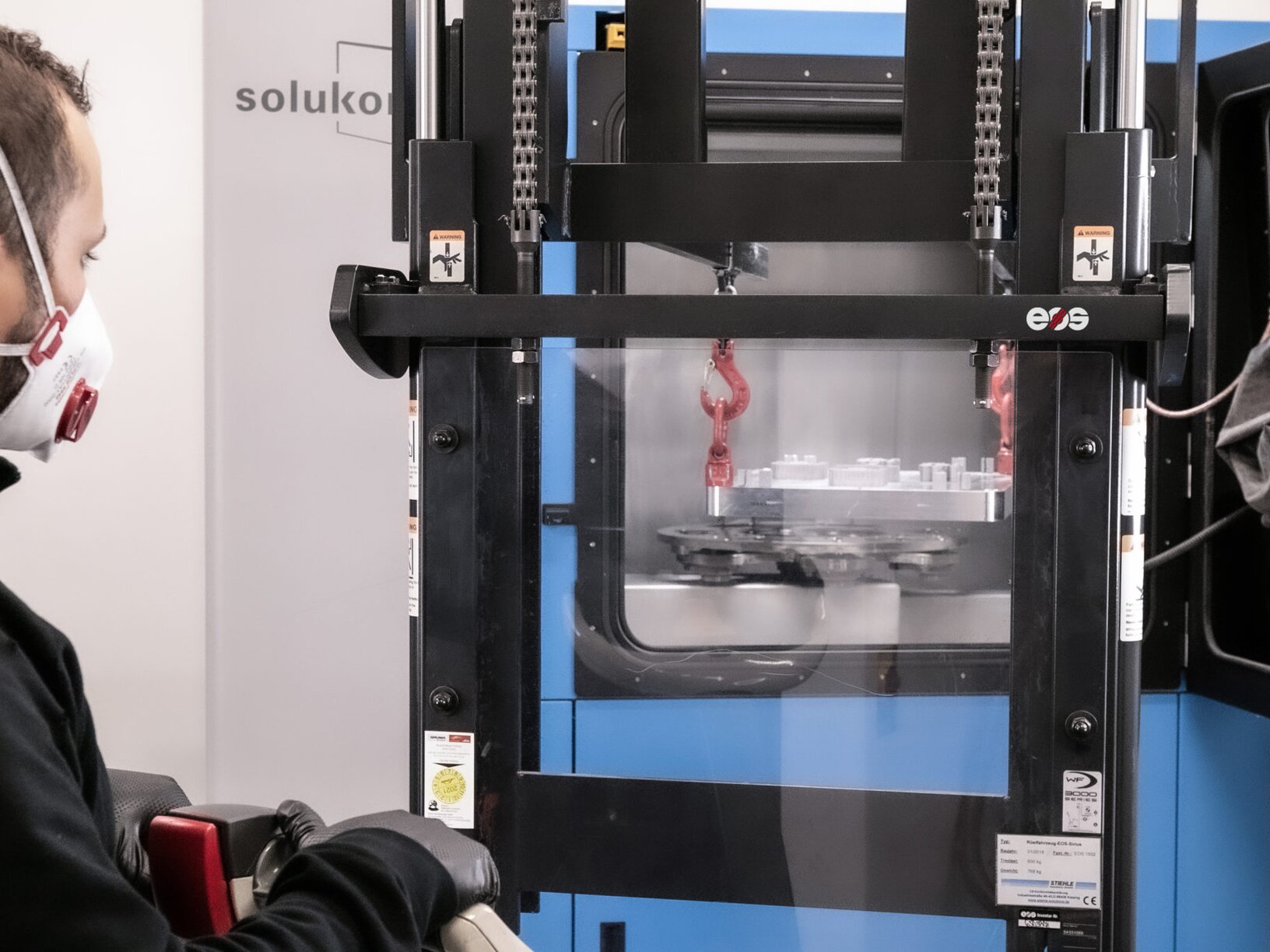
For many of Solukon's customers, operator health and safety are paramount, making manual depowdering a non-starter even for simpler parts. Beyond safety, large and heavy parts, such as those up to 1.5 or 1.6 meters in height that Solukon's largest machines can handle, are practically impossible to depowder manually.
Building such large systems presents its own engineering challenges. Solukon prioritizes "plug and play" devices, designing machines with constrained dimensions for whole-unit shipping, requiring only connections to compressed air and inert gas supplies.
For massive parts, Solukon machines feature large doors opening to 120 degrees for forklift access and even roofs that open vertically for crane loading.
Internally, the conveying system must handle significant powder volumes (as the powder often constitutes the majority of the initial weight) in an inert atmosphere, enabling high powder recovery rates — up to 99% as reported by one customer. This interface with powder handling systems is streamlined for the customer, often requiring just a two-wire connection for sensors to manage powder transfer while maintaining the inert atmosphere.
Ensuring Quality and Repeatability: Smart Depowdering
A key concern in depowdering is ensuring all material is extracted, especially from complex internal channels where particles can get trapped. Solukon addresses this through several features. Their machines incorporate a Digital Factory Tool (DFT), a sensor package that records extensive data during the depowdering process. This data allows customers to monitor the process in detail, export reports (even generating carbon footprint reports detailing energy and gas consumption), and ensure repeatability by adhering to established standards.
Programming the system's rotation and vibration patterns can be adapted to part complexity:
- Manual mode: Allows initial operator control to observe powder flow.
- Automatic mode: Sufficient for 50-60% of customers; the machine rotates the part through all possible orientations with vibration and high-frequency nozzle excitation for a set duration.
- Profile mode: For less complex geometries, users can program specific rotation angles and vibrator controls, either on the machine or a computer.
- SPR-Pathfinder®: The most advanced option, crucial for parts with intricate internal channels (e.g., 1.0 mm diameter channels are now common). This software voxelizes the
part, identifies all empty spaces, fills them virtually with powder particles, and then calculates the most efficient exit path for each particle, akin to emptying a stadium.
Design for Depowdering: Critical Considerations
Raj strongly agreed that designing for post-processing, especially depowdering, is often neglected. Common design mistakes include extremely narrow or blind internal
channels with no exit ports. Key design guidelines include:
- Ensuring exit ports for all channels.
- Maintaining a conservative length-to-diameter (L/D) ratio for internal channels (historically around 4, though Solukon now handles much more extreme ratios).
- Avoiding sharp angles in channels; opt for smooth, spiral-like structures.
- Minimizing internal surface roughness, as powder tends to stick to rough surfaces due to mechanical interlocking.
The SPR Pathfinder software aids this by allowing designers to simulate powder flow through internal channels before printing, identifying bottlenecks early in the design process. Solukon has successfully depowdered parts with channels as small as 0.4 mm in diameter, often utilizing an ultrasonic exciter that vibrates the part in the ultrasonic range (around 30-38 kHz) to break up clumped powder in very fine channels without damaging the part.
The Future: Robotics and Integrated Solutions
Raj revealed ongoing work to make depowdering "more automated, more smart," including the implementation of a robotic arm inside their machines, which can use specialized exciters to target specific bottleneck areas or perform automated blasting in hard-to-reach channels.
Solukon also continues to develop custom one-off solutions for unique client challenges, such as fully automatic loading and unloading while maintaining an inert atmosphere.
This evolution positions Solukon as a mechatronics-focused engineering company dedicated to providing complete depowdering solutions, not just machines.
Hemank Raj's insights underscore that automated depowdering is far from a simple add-on; it's an intricate, technology-driven process vital for quality, safety, efficiency, and cost-effectiveness in production AM. As the industry advances, such intelligent post-processing solutions will increasingly open up design opportunities and solidify AM's role as a viable manufacturing method for the most demanding applications.
Connect and Learn More:
- Connect with Hemank Raj on LinkedIn.
- Listen to the full Additive Snack Podcast episode.


