Top 5 Reasons Manufacturers Are Switching to EOS SLS 3D Printing
DECEMBER 18, 2025 | Reading time: 6 min
When you manufacture end-use polymer parts — whether for medical devices, industrial equipment or drones — speed and certainty matter as much as precision. For years, injection molding has been the obvious choice for high-volume plastic parts. But as product lifecycles shorten and supply chains get more fragile, the old model of “lock design, cut tooling, then scale” is often too slow and too rigid.
That’s why so many manufacturers who already use FDM or SLA for prototypes are now looking at selective laser sintering (SLS) as their next step. They need end-use quality, but they also need flexibility: fast iteration, low-to-medium volume production, and the ability to respond quickly to customer feedback.
In this article, we’ll break down the top five advantages of SLS 3D printing — and why EOS SLS systems have become a proven choice for production-ready polymer additive manufacturing.
1. No Support Structures, More Design Freedom
If you come from FDM or SLA, support structures are just part of the job. They hold overhangs in place, keep tall features from wobbling, and stop parts from peeling off the print bed — but they also slow everything down.
With SLS, there are no support structures. The unfused powder itself surrounds and stabilizes the part as it’s built, acting as a natural support matrix. That means you can:
- Build parts in virtually any orientation without worrying about support angles.
- Nest parts throughout the full build volume, not just on a single print bed layer.
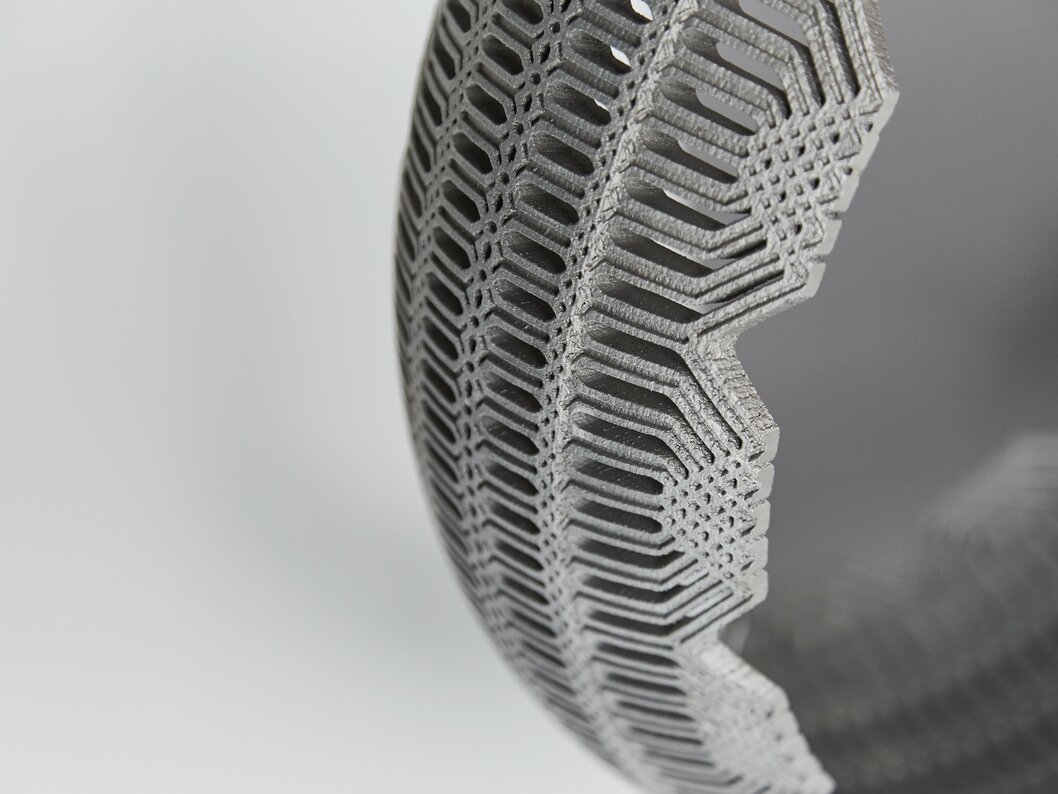
- Print complex features like large overhangs, organic curves and internal channels that would be painful — or impossible — to support in FDM or SLA.
There’s also less post-processing. Unlike other polymer additive manufacturing processes, you don’t have to spend time cutting, sanding, or dissolving supports, which can damage surfaces and introduce variability. You depowder, finish as needed, and move on.
For design engineers, this allows for a very different mindset: instead of designing around support constraints, you design around function.
2. Superior Mechanical Strength and Injection-Mold-Like Performance
As teams move beyond prototype-only work, they need polymer 3D printing processes that can deliver:
- End-use mechanical performance.
- Production-grade part quality and consistency.
- Freedom to iterate designs quickly with customers.
That’s where SLS comes in. Under the hood, SLS is a laser powder bed fusion process for polymers — which gives it very different part properties than filament- or resin-based technologies.
Where FDM parts can show weak layer-to-layer bonding and SLA parts can suffer from brittleness or creep, SLS parts are dense, mechanically robust and highly repeatable.
Key advantages:
- Isotropic, production-grade mechanical properties: SLS parts offer strength that’s comparable to injection-molded components, rather than the anisotropic behavior common in FDM.
- Low porosity and minimal defects: The tight packing of powder particles and precise laser control help create parts with very few voids or internal flaws.
- Engineering-grade thermoplastics: EOS SLS systems use the same types of thermoplastics you already know from traditional manufacturing — including PA12, PA11, TPU, and flame-retardant materials.
- Chemical resistance and thermal stability: Material properties such as modulus, tensile strength, chemical resistance and heat resistance can match what you see in molded parts.
For functional prototypes, this means you can test with confidence. For end-use components, it means you can actually place SLS parts into the field — not just into the lab.
That’s exactly what many manufacturers do with EOS SLS systems today: they produce polymer components whose performance and surface finish surprise customers used to thinking “3D-printed” means “prototype only.”
3. Scalable Production and Batch Efficiency
SLS is built for throughput and scalability, not just one-off prototypes. Instead of printing a single part per run, you can tightly pack multiple parts — or multiple assemblies — into a single build volume.
In practice, manufacturers often:
- Load full build volumes with a mix of parts and assemblies.
- Start longer builds before the weekend.
- Return to consistent, ready-to-finish parts that can move directly into depowdering and post-processing.
For manufacturers, that translates into:
- High batch efficiency: You use the entire build volume, not just a flat bed area. Parts can be stacked and nested in 3D, which drives down cost per part.
- Seamless scale-up: You can start with low-to-medium volumes and then scale to serial production using the same SLS technology. EOS SLS delivers proven reliability across that journey, from R&D to full production fleets.
- Shorter time to market: You can run pilot production and early customer programs on the same SLS platform you’ll later use for ramped-up output — no long tooling lead times in the way.
Once an SLS build finishes, parts come out as-printed and ready for depowdering and finishing. There’s no curing bath or solvent wash step that can introduce distortion or delays.
For business leaders and operations managers, this kind of agile polymer additive manufacturing reduces risk: you can validate both the product and the market before committing capital to hard tooling.
4. Material Versatility and Customization With EOS + ALM
One of the biggest reasons manufacturers outgrow their first polymer AM platform is material limitations. Maybe the filament options don’t cover the right chemical resistance, or the resin can’t handle the real-world temperatures.
SLS offers one of the broadest material portfolios in polymer additive manufacturing — and EOS has a unique advantage through its sister company, Advanced Laser Materials (ALM).
Together, EOS and ALM provide:
- A comprehensive range of engineering-grade powders, including PA12, PA11, TPU, flame-retardant, and ESD-safe materials.
- Application-specific options, from flexible TPUs for cushioning and seals to carbon-fiber-reinforced materials, as well as high-temperature, flame-retardant materials for aerospace and electronics.
- Custom blends and open parameter access for advanced users who need to fine-tune properties for niche or high-demand use cases.
For manufacturers, this means you’re not locked into a narrow material palette. You can match mechanical, thermal, regulatory and aesthetic requirements more precisely — often with materials that already fit into your existing qualification frameworks.
As your applications evolve, the EOS + ALM ecosystem gives you room to grow without switching technologies.
5. Workflow Efficiency and Predictable Total Cost of Ownership
A successful production technology isn’t just about the parts. It’s also about the workflow — and how predictable your costs are.
SLS simplifies operations in several ways:
- Predictable cost structure: With SLS, your primary variable cost is powder usage. There are no surprise consumables like support materials, resin vats or binding agents, and unused powder can often be refreshed and reused in future builds.
- Efficient powder handling and recycling: EOS SLS systems are designed with practical powder management in mind, so you can maintain high utilization while minimizing waste.
- Integrated software and process control: The EOSPRINT software platform provides an intuitive, workflow-oriented interface with fine control over laser parameters and build settings, layer by layer.
On top of the hardware and software, EOS brings a mature ecosystem to help de-risk adoption and scale:
- Additive Minds, EOS’s consulting and training team, helps you identify the right applications, optimize designs for SLS, and build a roadmap from prototyping to production.
- Simulation tools, including FEA-based approaches, help you predict whether a part will pass or fail before you ever hit “print.”
- Global service and partner network, including CAD/CAM, post-processing and material partners, supports you as you bring more advanced SLS challenges in-house.
The result is a polymer additive manufacturing platform with a predictable total cost of ownership — and a clear path from your first part to a fully integrated production workflow.
Why EOS SLS for Polymer Additive Manufacturing?
At the surface, moving to SLS might look like a simple equipment upgrade. In reality, it can be a strategic shift in how you design, validate and produce polymer parts.
With EOS SLS, manufacturers can run on a digital inventory model: parts live as qualified CAD files instead of boxes on shelves. Production is triggered on demand, based on real usage and real orders, not forecasts. That reduces warehousing, obsolescence, and safety stock — and makes it far easier to localize production, so parts are printed closer to the point of use.
Across industries, engineering teams use EOS SLS to:
- Consolidate multi-part assemblies into single, optimized components.
- Add internal channels and features that molding can’t achieve.
- Tailor ergonomics and performance to specific users without waiting for new tools.
No matter the application, the pattern remains the same: SLS 3D printing delivers injection-mold-like part quality, with the agility and flexibility of digital manufacturing.
See the Full Picture: Top 5 Advantages of SLS 3D Printing for Manufacturers
If you’re currently relying on FDM, SLA, or other polymer AM technologies — and you’re starting to bump into their limits — SLS is likely the next logical step.
Watch Video #1: Top 5 Advantages of SLS 3D Printing for Manufacturers
(Link to HubSpot landing page – URL TBD)
In this video, you’ll see how SLS 3D printing, and the EOS SLS ecosystem in particular, help manufacturers move from prototype-only parts to production-ready polymer additive manufacturing.