
No Ropes, No Limits: WCB Robotics Scales Smart Facade Cleaning With EOS SLS
WCB Robotics | Case Study
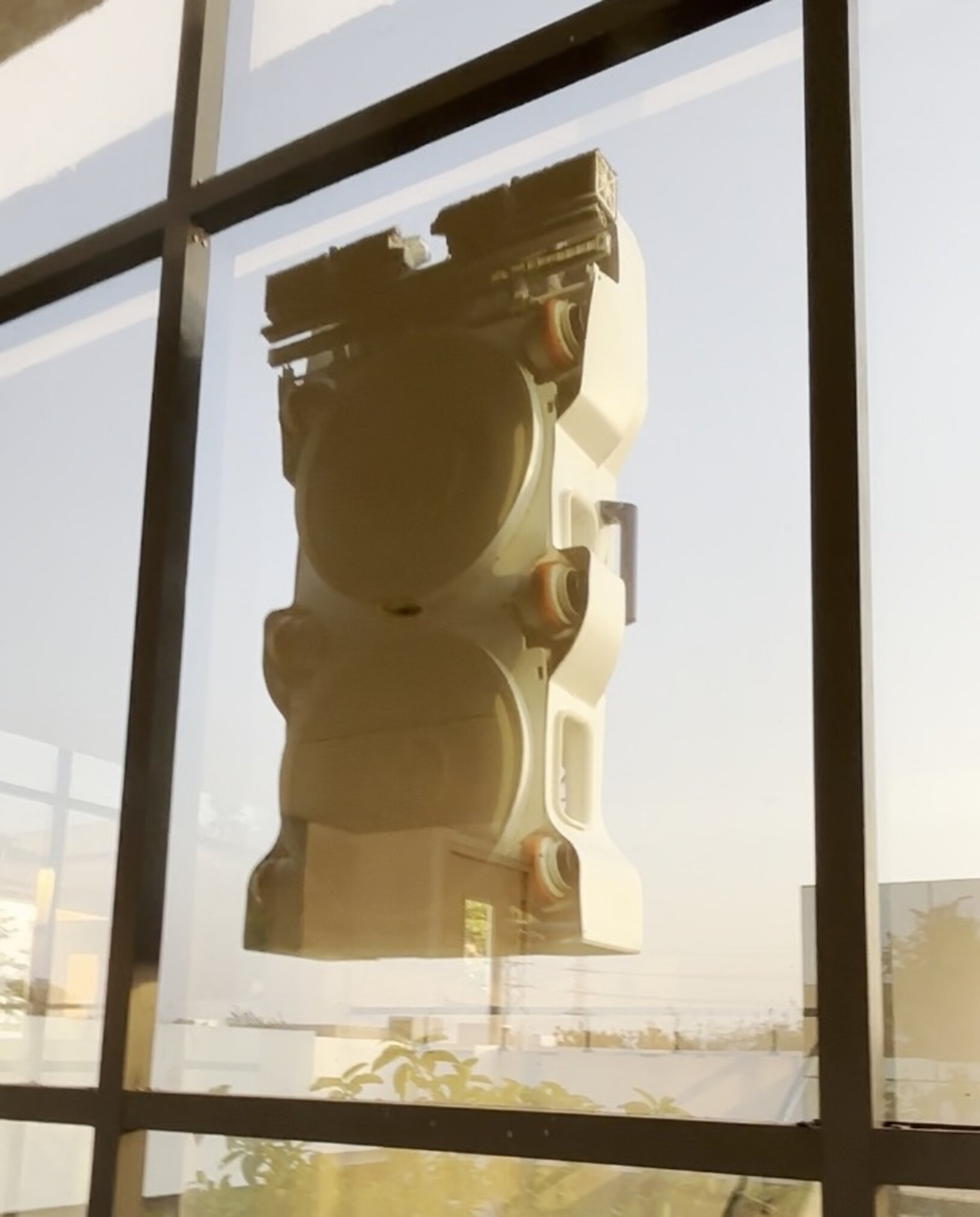
Every day, crews still dangle from ropes to clean skyscraper glass — dangerous work that’s slow, costly, and weather-dependent. WCB Robotics set out to change that with E.L.M.O., a battery-powered, ropeless façade-cleaning robot that climbs and cleans with human-like quality while using just about 1 liter of water per clean. Weighing under 16 kg and engineered to stay secure even in winds up to 100 km/h, E.L.M.O. brings consistent quality and safety to a task that still relies on manual labor in 99% of skyscrapers.
To deliver that leap, WCB Robotics needed production-ready parts that meet tight tolerances, shrug off heat, humidity, and UV, and keep total system weight low — across more than 500 unique components. Traditional machining and consumer-grade 3D printing could not keep up. EOS selective laser sintering (SLS) with PA 2200 unlocked the design freedom, durability, and repeatability the team needed to move from prototypes to a robust, field-ready product.
Challenge
As designs evolved, WCB Robotics’s parts outgrew the constraints of lathe/CNC machining and acrylic sheet fabrication. Complex internal channels, AI optimised organic geometry and ever-tighter tolerances made machining slow, expensive, and — in many cases — impossible. Trials with FDM and SLA exposed limitations: inconsistent tolerances, poor creep and temperature resistance, durability concerns, and labor-heavy support removal that damaged parts and slowed throughput . The team needed production parts straight from the build, with the stiffness-to-weight and environmental resilience required for a robot that must work worldwide — from 55 °C and 99% humidity to sub-zero in dry winters — without ballooning cost or lead time.

Solution
WCB robotics standardized on EOS SLS and Nylon material to manufacture structural chassis elements, a fully SLS-printed robot cover, and key assemblies — including a lightweight peristaltic pump, a patent-pending multi-port water bottle, and a CFD-optimized squeegee — directly from the printer into service.
“3D printing helps us transcend the boundaries of traditional manufacturing into a haven where form is dictated only by function. With every layer, EOS’s SLS machines breathe life into a dreamer’s imagination — bringing to life products like our robot E.L.M.O. that could never be made before.”
Ujjawal Aggarwal, Founder of WCB Robotics.
EOS SLS eliminated the need for support removal, preserved delicate features, and enabled the creation of fine details down to ~0.5 mm without compromising structural integrity. The material choice — EOS PA 2200 — delivered the right combination of stiffness-to-weight, creep resistance, thermal stability, and moisture resistance. Crucially, EOS process consistency gave WCB Robotics repeatable quality across batches, cutting rework and simplifying downstream assembly. In WCB Robotics’s words, this was the decisive factor that turned small-batch, high-complexity production from prohibitively expensive into viable operations.
“The decisive factor was PA 2200’s performance and the repeatability of EOS’s machines. We get complex geometry, ultra-lightweight design, and dimensional control in one shot — no compromises.”
Engineering team - internal summary, WCB Robotics
Results
The switch to EOS SLS changed both product capability and business cadence. Technically, WCB Robotics achieved consistent dimensional control across 500+ unique parts, integrated internal flow paths that machining could not realize, and durable polymer components that withstand harsh climates while keeping system mass low. Operationally, the team removed support-removal labor, reduced scrap, and shortened iteration loops — accelerating time-to-market and enabling fieldable builds that run at a quiet ~75 dB while maintaining cleaning quality.
WCB Robotics’s cleaning robot E.L.M.O. is now operating reliably with the 3D printed pump, water bottle, squeegee, drive systems and cover. Manufacturing can easily be scaled and based on the market needs. This comes with low operational risk, as demand-based production minimizes warehousing costs and the risk of overstocking.
“EOS SLS didn’t just make the robot possible — it made the business scalable. We can iterate fast, build repeatably, and ship with confidence.”
Ujjawal Aggarwal, Founder, WCB Robotics
Because the robot’s complexity increased significantly after moving to SLS, like-for-like testing against earlier methods wasn’t feasible. However, in practice, many current parts couldn’t be machined at the target weight to begin with. For certain components, WCB observed up to 5x cost delta versus machining, underscoring why SLS is the only viable path for small-batch, high-complexity production.

At a Glance
- 18 x less support-related labor time by eliminating supports and minimizing post-processing. One representative example, a suction cup, dropped from about 9 hours of manual work to roughly 30 minutes.
- Accelerated time-to-market through rapid design iteration and direct manufacturing of functional end-use parts.
- Lowered unit cost for small-batch, high-complexity builds by consolidating multi-step machining into single SLS builds. In specific cases, SLS proved up to 5x more cost-effective than machining.
- Improved field reliability across temperatures and humidity: consumer-grade FDM parts typically failed around 45° C, whereas SLS parts have remained robust — even with slimmer designs — at up to 60° C.
- ~ 68 % reduced system mass by enabling the 16 kg target; a comparable machined design is estimated at 30-50 kg.
- Demonstrated quiet operation at ~75 dB — suited for live expos and indoor demos — while maintaining cleaning quality (made possible by geometry tailored to the application).
Short Company Profile
WCB Robotics (Hyderabad, India) builds E.L.M.O., a ropeless, smart façade-cleaning robot that cleans high-rise glass safely and sustainably. E.L.M.O. uses patented contact-less suction, automotive-grade safety electronics, and sips ~1 L of water per clean while operating in winds up to 100 km/h.


