Can Additive Manufacturing Really Reduce Environmental Impact Compared With Traditional Methods?
3D Printing Sustainability: Why Supply Chain Engineers Are Betting on Additive Manufacturing
06 August, 2026 | Reading time: 6 min
Across industries, manufacturers are feeling unprecedented pressure to reduce their carbon footprints. Regulators are tightening emissions reporting rules, investors are scrutinizing ESG metrics, and customers increasingly favor suppliers that can demonstrate measurable sustainability credentials.
This guide explores exactly where sustainable 3D printing excels, where challenges remain, and what manufacturers need to know before scaling additive manufacturing (AM). From cutting material waste to leveraging localized production, this article outlines the practical steps that transform AM from promise to measurable impact.
Sustainability, the Carbon Footprint, and Efficiency
Sustainability has shifted from one of many considerations to a central pillar of competitiveness. One major reason for this is the link between efficiency and sustainability. Processes that use less energy and produce less waste lessen the environmental impact, while also boosting efficiency and therefore saving manufacturers money.
For engineers evaluating production technologies, AM stands out for its ability to deliver measurable efficiency and sustainability improvements. A recent life cycle assessment of metal AM found that, across aeronautics and industrial machinery case studies, AM cut environmental impact by over 60% compared with conventional manufacturing, largely by reducing material waste.
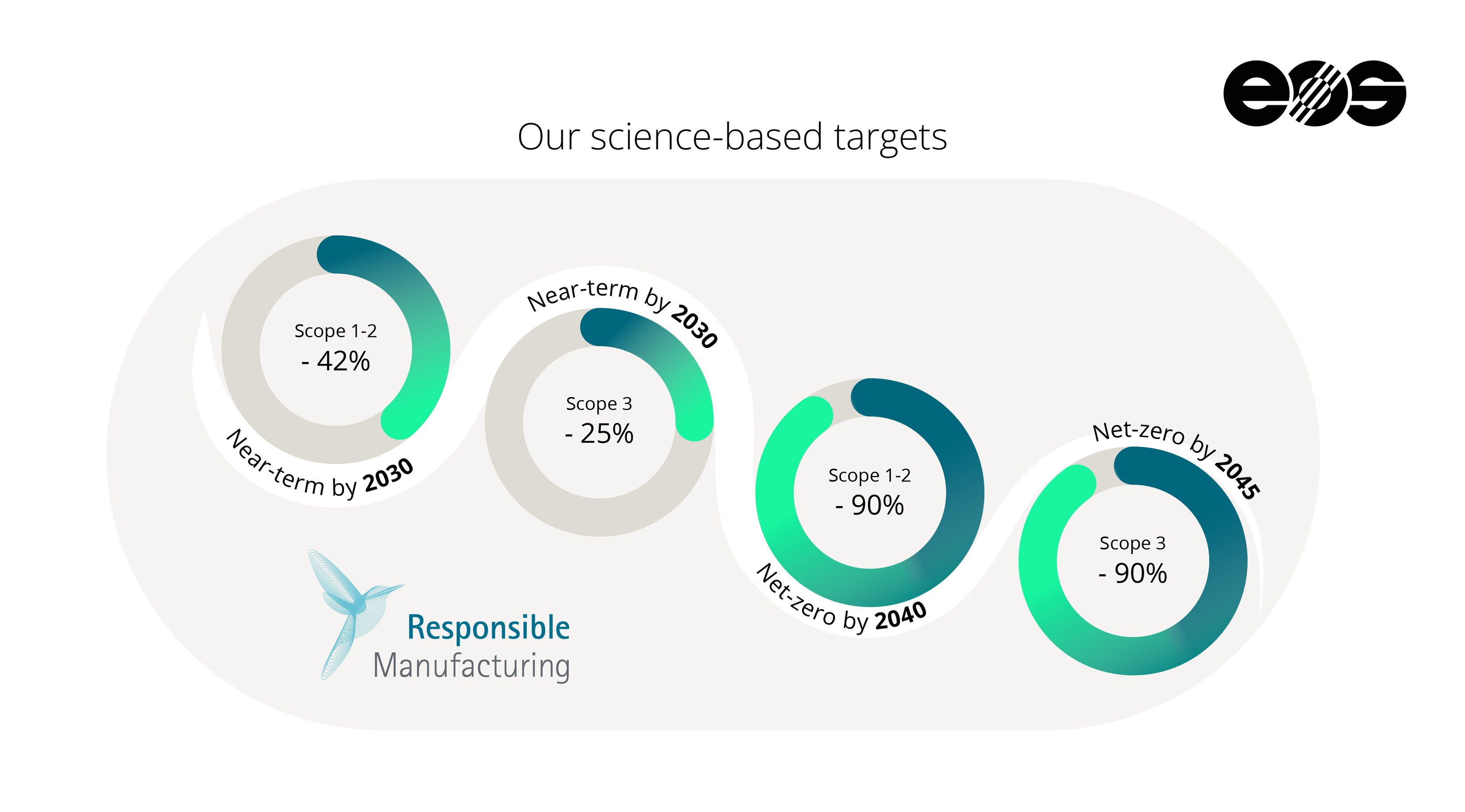
EOS formalized its commitment to climate protection and carbon reduction by validated science-based targets that track progress toward net-zero. At EOS, we have science-based targets (set against a 2022 base year) for all scopes and both near-term and net-zero reduction targets. These are:
- 42% absolute reduction in Scope 1 and 2 CO2e emissions by 2030.
- 25% absolute reduction in Scope 3 CO2e emissions by 2030.
- 90% absolute reduction in Scope 1 and 2 CO2e emissions by 2040.
- 90% absolute reduction in Scope 3 CO2e emissions by 2045.
Companies that follow GHG Protocol-aligned carbon accounting can more easily comply with regulations like the EU’s Corporate Sustainability Reporting Directive, which demands full transparency across Scope 1, 2, and 3 emissions. This is backed by the EOS Environmental Management System in Germany, certified under the ISO 14001 standard which formalizes continuous improvement in environmental performance.
Furthermore, research demonstrates this financial upside. A Massachusetts Institute of Technology thesis comparing AM with injection molding found that leveraging AM for a sports-equipment case study delivered a 75% smaller environmental footprint per part.
What Industries Benefit From Sustainable 3D Printing?
The environmental advantages of 3D printing are already helping organizations across sectors increase their sustainability levels. Examples include:
- Aerospace: Engineers use 3D printing to create lightweight bionic structures that significantly reduce aircraft weight, leading to lower fuel consumption and a smaller carbon footprint over the craft’s lifecycle. Lower fuel consumption and efficiency have a direct effect on costs and potentially also payload.
- Medical: By producing patient-specific implants and prosthetics on-demand, the healthcare industry reduces the material waste and energy costs associated with traditional mass-manufacturing and large inventories. Moreover, these patient-specific implants and ortheses significantly improve the situation for the patient.
- Automotive: Manufacturers leverage additive technologies to consolidate multiple components into single, lightweight parts, minimizing raw material waste and improving the energy efficiency of electric vehicles. Using lightweight parts, and fewer of them, cuts costs in production and saves on fuel.
- Consumer Goods: Brands in the eyewear and footwear sectors are adopting 3D printing to enable a "zero-inventory" model, preventing the deleterious environmental effect of overproduction and the disposal of unsold stock. Eliminating overstock cuts costs, and the customization of goods improves the user experience.
- Energy: The energy sector uses 3D printing to manufacture optimized components for gas or wind turbines that maximize energy efficiency. And in energy, efficiency is money.
How Additive Manufacturing Tackles the Supply Chain Carbon Problem
Moving parts, raw materials, and tooling across continents is one of the most carbon-intensive elements of traditional manufacturing. Peer-reviewed research shows that integrating AM can significantly reduce costs related to transport and warehousing while cutting associated waste, thanks to the ability to print components exactly where and when they are needed.
For a deeper dive into how distributed manufacturing dovetails with broader ESG goals, explore our latest EOS Sustainability Report, which outlines the practical steps we and our customers are taking to embed localized production, digital inventories, and circular material flows across global supply chains.
To further illustrate the benefits, consider eyeglass manufacturing. EOS 3D printing enables the local production of highly personalized, made-to-measure eyewear that provides an excellent fit by tailoring frames to a customer's unique facial scan. The technology produces frames that are 30% lighter and more durable than traditional materials while allowing for complex, aesthetic lattice structures. Additionally, AM enhances sustainability and business efficiency by significantly reducing time-to-market, minimizing overproduction, and enabling the cost-effective production of custom designs.
The Sustainability Profile of Additive Manufacturing: Benefits and Challenges
Besides localized production, another advantage of AM is its ability to create geometry with high precision, depositing material only where it is structurally necessary. AM can streamline resource use. By building near-net-shape parts, AM reduces material consumption and waste, benefits that ripple across the entire product life cycle.
To understand the breadth of those advantages, consider the following areas where sustainable 3D printing often outperforms traditional manufacturing:
- Consolidation of complex assemblies into single-printed parts enables lightweighting that improves fuel or energy efficiency in service.
- Digital inventories enable on-demand production, curbing excess material inventory and the waste of obsolete spares.
- The use of recycled material or reuse of unfused powder feedstock, supporting circular sustainable material flows.
However, these advantages come with considerations. Powder bed fusion often involves more energy consumption than machining on a per-kilogram basis for like-for-like parts, and the energy and resources needed to produce the powders are higher than producing plastic granules and pellets or sheet and bulk metal. The true benefit often depends on redesigning components for performance gains that offset production-phase emissions. Life-cycle thinking — from energy sourcing to part usage and end-of-life handling — is essential for an accurate sustainability ledger.
AM’s sustainability profile is strongest when engineers pair intelligent design, efficient operations, and responsible materials. When those pieces align, AM transforms from a prototyping tool into a cornerstone of low-carbon, resource-efficient production.
What Determines How Sustainable Your 3D Printing Operations Actually Are
From cradle-to-gate, the biggest emissions impact stemming from AM results from the materials used. Switching from virgin powders to circular, lower-impact feedstocks can unlock double-digit percentage savings. For example, our Aluminium AlSi10Mg now relies on 100% recycled content that delivers an 83% reduction in CO₂ emissions versus its previous formulation. This shows that selecting the right 3D printing material can transform both environmental impact and cost efficiency.
Carbon-reduced polymer materials are another example. Using carbon-reduced PA12 raw polymer powder provides another method of achieving emission reduction. In addition to PA 2200 CarbonReduced, EOS recently changed PA 2201 and PA 3200 GF entirely to carbon-reduced raw materials, lowering the footprint by more than 30%. Bio-based polyamide 11 powder made from castor oil has a very low carbon footprint as a conventional grad. Combined with a clear pathway to further lowering the environmental footprint and offsetting all production emissions, this material is offered climate-neutral according to ISO 14068-1.
Material efficiency in the process and operational discipline are equally critical. From careful build-chamber packing to robust powder-recycling protocols, day-to-day decisions dictate whether AM realizes its full sustainable manufacturing potential. As we note in our RFS Pro filtration overview, the system separates and recovers reusable powder fractions with high efficiency, enabling recovery rates of 50%–95% and reducing as much as 30 tons of CO₂ emissions per machine each year, contributing to both cost and carbon reduction.
It’s also worth examining the energy source that powers the 3D-printing process. Operations supplied by renewable energy routinely outperform fossil-fuel-based sites by a wide margin, making energy sourcing an important factor in reducing production-phase carbon emissions. Selecting regions with abundant green power can be a decisive factor in cutting production-phase emissions and reaping the full benefits of sustainable manufacturing.
The Future: Where 3D Printing and Sustainability Intersect
Bio-based or other carbon-reduced polymer and metal powders derived from recycled material point toward a future in which sustainable materials are the default, not the niche. As these options mature, engineers will match application performance with dramatically lower embodied carbon while still meeting the tight specifications demanded in aerospace and automotive programs.
Just as important, digital inventory strategies promise to eliminate entire tiers of logistics. By pairing secure part libraries with a geographically dispersed fleet of qualified 3D printers, manufacturers can print certified spares on demand within hours.
Closing the loop on materials will also be key. The VIRTUCYCLE® program diverts spent polymer powders from disposal by converting them into high-performance granules, a process that saves up to seven kilograms of CO₂ for every kilogram recycled — tangible evidence that circular economy principles can scale across industrial volumes.
As AM continues to mature, the line between innovation and responsibility is blurring. For supply chain engineers, the message is clear: The most competitive factories of tomorrow will be the ones that fuse cutting-edge 3D printing technology with uncompromising sustainability standards that unlock valuable efficiency gains.
Frequently Asked Questions
Here are some FAQs about sustainable practices in AM:
What’s the Environmental Profile of Common 3D Printing Materials?
Does Additive Manufacturing Produce Environmental Harm?
How Much Waste Material Does AM Generate?
What’s the Overall Carbon-Footprint Impact of 3D Printing for Production?
Take the Next Step Toward Sustainable Manufacturing
Reducing material waste, trimming logistics emissions, and meeting demanding climate targets are no longer distant ambitions; they’re today’s engineering mandates. If you’re ready to see how industrial 3D printing technology can advance both your operational efficiency and your sustainability agenda, we’re here to help.
Connect with our AM experts to map a data-driven path toward lower carbon footprints, lighter components, and more resilient supply chains.
CONTACT US / BOOK A CONSULTATION
Prefer to explore on your own first? Visit the EOS product pages to discover metal and polymer platforms engineered for responsible manufacturing.

