
3D Printing in Oil & Gas
Reliability and Supply Chain Resilience in the World’s Harshest Environments
The oil and gas industry operates in some of the most demanding conditions on the planet. Extreme temperatures, high pressures, corrosive environments and remote locations place exceptional stress on components and systems. At the same time, operators face rising costs, ageing infrastructure and increasingly fragile supply chains, all while being under pressure to improve safety and reduce emissions.
Additive manufacturing (AM) offers a new way to design, produce and maintain critical parts across upstream, midstream and downstream operations. By enabling on‑demand production, advanced design capabilities and material efficiency, AM helps operators improve reliability, reduce downtime and respond faster to operational challenges.
Challenges in the Oil & Gas Industry
Oil & gas operations are shaped by complex technical and economic pressures:
Why Additive Manufacturing for Oil & Gas
Additive manufacturing enables a fundamentally different approach to designing and producing oil & gas components:
- On demand spare parts: AM reduces lead times from months to days, supports digital inventory strategies and helps reduce inventory costs, while ensuring availability of critical components even when OEM support is no longer available.
- Improved performance in harsh environments: Corrosion resistant alloys and optimized geometries increase durability and operational stability.
- Reduced downtime and maintenance costs: Faster production and replacement help maintain system reliability and reduce unplanned shutdowns.
- Design freedom for complex components: Internal channels, lattice structures and topology optimized geometries improve flow, heat transfer and structural integrity.
- Greater operational flexibility: AM enables rapid iteration of components tailored to specific field conditions or performance objectives.
From offshore platforms to refineries and LNG facilities, AM is becoming a strategic tool for improving reliability and supply chain resilience.
Applications of 3D Printing in Oil & Gas
AM is already successfully used across a broad range of oil & gas components. These applications demonstrate how AM is transitioning from experimental use cases to qualified, production ready solutions in real operational environments:
- Valves and valve components: Improved corrosion resistance, reduced weight, optimized flow paths.
- Flow control and measurement devices: Enhanced flow stability and thermal behavior for higher measurement accuracy.
- Corrosion resistant components: Super duplex, nickel alloys and titanium parts designed for extended service life.
- Complex manifolds and internal channels: Highly efficient, space saving geometries impossible to manufacture conventionally.
- Spare parts for legacy equipment: Fast replacement of obsolete components without original tooling.
Corrosion Resistant Valve Components
In aggressive saltwater environments, valve components often suffer from rapid corrosion and short replacement intervals. Through AM, components were redesigned to improve corrosion resistance, extend service life and reduce material usage, demonstrating substantial cost and performance benefits.
- 1 Week Lead Time
- 30% Total Cost Reduction
- 15% Weight Reduction

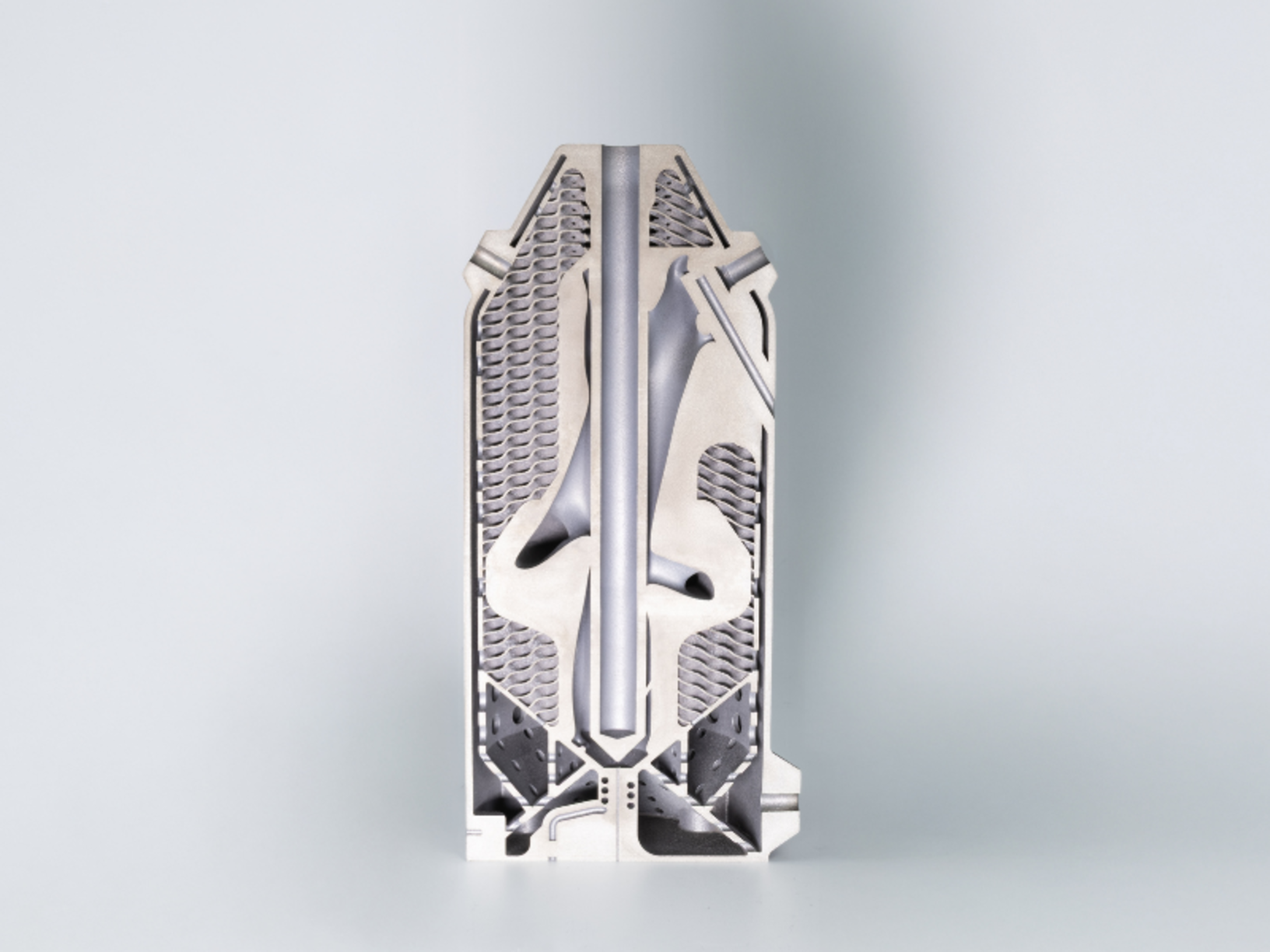
LNG Vaporizer Improved Measurement Stability
In LNG processing, even small deviations in flow or temperature can impact measurement accuracy and commercial value. Using AM, the vaporizer design was optimized to improve flow behaviour and thermal uniformity, resulting in significantly more stable measurement performance and increased process reliability.
- >50% Reduction in GHV Measurment Variability
- 279 mm Aluminium Component
- 150 bar(g) Proof Tested, ATEX-ready
Scaling AM in Oil and Gas: From Prototyping to the Digital Supply Chain
ExxonMobil is shifting from experimental 3D printing to a site driven digital supply chain. Enabled by the API 20S standard, refineries can now produce qualified metal components, such as impellers, on demand using LPBF.
By replacing large physical inventories with digital part files and shared industry databases, the company reduces storage costs, speeds up replacement cycles and strengthens supply chain resilience. Workforce programs and digital readiness initiatives further accelerate adoption across global sites.

Why EOS for Oil & Gas Applications
EOS combines deep expertise in metal additive manufacturing with a long track record of supporting highly regulated and mission critical industries. For oil & gas operators, this translates into:
- Reliable and repeatable industrial production
- High performance materials suitable for corrosive, high pressure environments
- Support for qualification and certification processes (e.g., DNV, API)
- Proven applications and validated use cases across upstream, midstream and downstream
- A global ecosystem of partners supporting design, testing and production
- Systems designed for durability, traceability and long term operational stability
EOS helps oil & gas companies unlock the full potential of additive manufacturing from rapid prototyping to fully qualified serial production enabling more resilient, flexible and efficient operations.

