

Polymer Additive Manufacturing Periphery
Our comprehensive suite of solutions unlocks the full potential of every polymer-based 3D print, empowering industries to harness the transformative power of additive manufacturing. From material handling and process optimization to post-processing methods and expert-led training, EOS offers a holistic approach to 3D-printed polymers to elevate your manufacturing endeavors.
MATERIAL MANAGEMENT
Efficient Material Flow Solutions
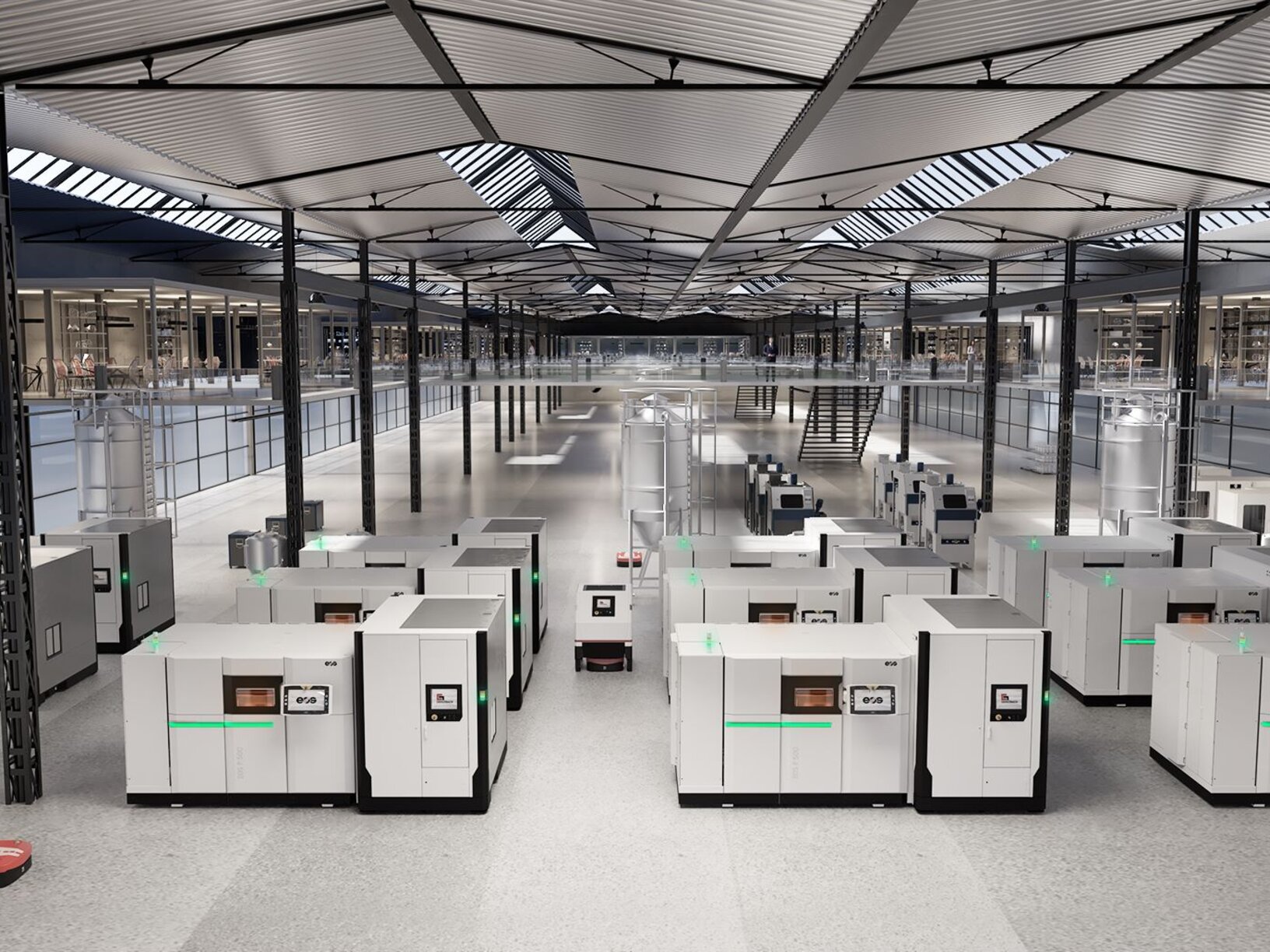
We offer a range of material handling solutions with different degrees of automation across unpacking, sieving, mixing, and feeding powder. Our modular polymer 3D printing solutions can easily grow with your manufacturing needs. To adapt to a wide range of manufacturing needs, we collaborate with third-party experts for optimal results.
Measurable reliability across the board
- 92% machine availability
- Up to 71% utilization
- 98% homogeneous parts in one build
With a semi-automated or fully automated setup, you can also increase your builds per year and guarantee repeatable and reproducible quality across builds and machines.
Additional periphery equipment such as mixing and qualification stations take care of material management in parallel to the actual 3D printing process, thus reducing the setup time between build orders while minimizing contact to material and enhancing work safety.
If you’re just starting your additive manufacturing journey, our cost-effective manual solutions are easy to set up, even for a range of printing materials. As your 3D printing needs evolve, our solutions can adapt and scale alongside your business and production line. For high-volume manufacturing, our solutions even allow for batch tracing in a closed production cycle, thus meeting the highest standards for both quality and safety.
POST-PROCESSING
Refine Components and Streamline Workflow
Enhance the appearance and functionality of 3D-printed polymer parts straight from the 3D printer with various post-processing methods. Parts that require a glossy finish can be refined to meet specific material property requirements.
Options include depowdering to remove excess material or the usage of glass beads or CO2 ice to gently compact and smoothen the surface without material removal. As a result, the 3D-printed parts have a matte glossy finish that’s scratch- and dirt-resistant. Chemical smoothing dissolves the part’s surface, leaving it smooth, highly glossy, sealed, and washable, thus achieving an injection molding look.
Dyeing and spray painting offer an unlimited selection of ISO-certified colors for a final touch. Galvanization allows metalizing surfaces and enhancing functionality. This completes the possibilities to meet the broadest range of industry applications and requirements.


