
Advanced Manufacturing for Electronics
High-Performance Liquid Cold Plate Cooling Enabled by a Siemens End-to-End Digital Thread and EOS Metal AM
High-performance electronics place increasing demands on thermal management solutions. Rising power densities, compact system architectures, and growing sustainability requirements are pushing conventional cooling concepts to their limits. In sectors such as data centers, electric mobility, and aerospace and defense, efficient and reliable liquid cold plate cooling is a key enabler for performance, system lifetime, and operational efficiency.
In this case study, Siemens, GKN Additive and EOS, demonstrate how additive manufacturing for electronics enables a new generation of direct-to-chip liquid cold plates. Presented by Siemens at Formnext 2025, this example shows how a comprehensive end-to-end digital thread, combined with industrial metal additive manufacturing on EOS systems, unlocks superior cooling performance for high-performance electronic applications.
Challenge
The limits of conventional electronics cooling. Liquid cold plates already offer significant advantages over forced air cooling. However, most conventional solutions are still based on tube-based or vacuum-brazed pin designs, which impose several limitations:
- Restricted design freedom, limiting thermal optimization
- Reliability risks due to brazed joints acting as potential leak points
- High cooling-related energy consumption, especially in data centers
- Reduced system lifetime, as elevated temperatures are responsible for around 50% of electronic equipment failures
As a result, cooling decisions directly impact efficiency, sustainability, reliability, and total cost of ownership.
Solution
A comprehensive digital thread from heatmap to print-ready cold plate. To overcome these challenges, Siemens developed a comprehensive end-to-end digital thread for direct-to-chip liquid cold plate cooling, covering the entire process from thermal simulation to a production-ready additive design.
From Thermal Requirements to Optimized Additive Design

- The digital workflow starts with the simulation of the IGBT heat profile using Siemens Calibre 3D Thermal, generating detailed three-dimensional thermal heatmaps. These heatmaps define the cooling requirements and serve as the basis for downstream optimization.
- The thermal data is transferred into Simcenter OptiStruct, where convection topology optimization is applied to maximize heat transfer while minimizing pressure drop. This results in highly efficient cooling channel architectures that are not achievable with conventional manufacturing methods.
- The optimized topology is then converted into a printable geometry using Simcenter Inspire implicit modeling, enabling true “Design for Additive Manufacturing” (DfAM) and allowing the integration of complex internal structures such as lattices or optimized flow channels.
- To ensure optimal thermal and flow performance, the resulting designs are validated using CFD simulations in Simcenter Flotherm, enabling direct comparison between different additive cooling concepts and traditional pin-based designs.
- The digital process chain concludes with build job preparation in Siemens NX AM Fixed Plane, enabling a seamless transition from design to manufacturing without data breaks. Automatic nesting allows efficient packing of a high number of cold plates per build on EOS metal AM systems. This ensures high machine utilization, reproducible production conditions, and reduced build time per part, supporting efficient and scalable series production.
Prepare the Production Print Job in Siemens NX-Fixed-Plane Advanced
Additive Manufacturing for Serial Production on EOS Metal Systems
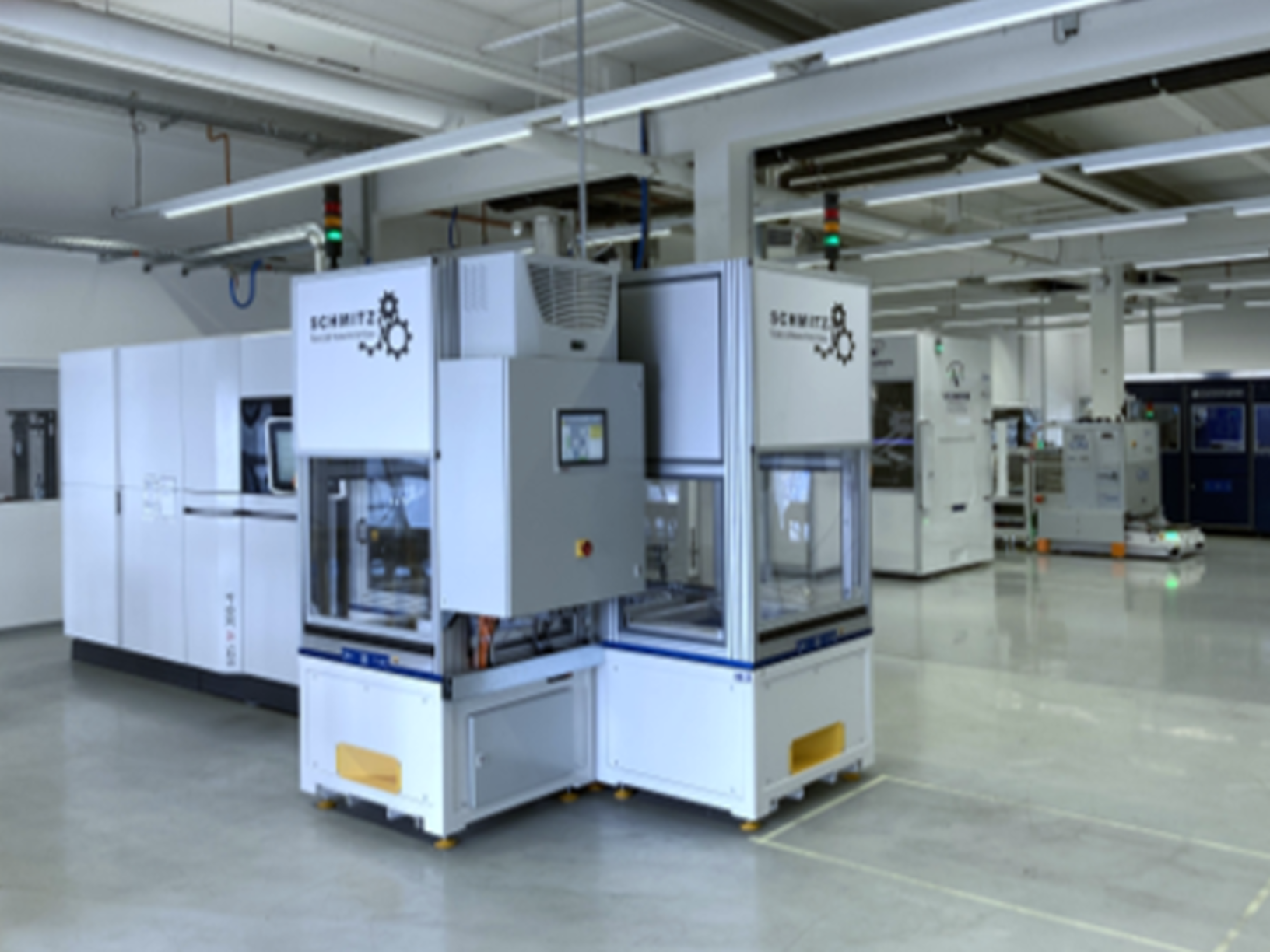
The optimized liquid cold plates are manufactured by GKN Additive, leveraging extensive expertise in industrial metal additive manufacturing and serial production. With a broad metal application portfolio especially with high thermal conductive material like copper and aluminum alloys and a large installed base of EOS metal systems, GKN Additive supports a wide range of industrial AM applications and serves as a reliable production partner across diverse use cases.
GKN operates a fleet of EOS metal systems across the M2, M3 and M4 platforms, enabling production setups for a wide range of applications. This diversity of platform capabilities allows GKN to flexibly adapt manufacturing configurations to specific performance and material requirements, from high‑conductivity copper components to stainless‑steel parts and many more.
This industrialized environment is reinforced by advanced process know-how, automated powder handling, machine build management and post-processing, as well as digital process monitoring and quality assurance. Together, these capabilities enabled by decades of powder metallurgy production processes ensure reproducible part quality, high process stability, and scalability across different machine platforms and materials.
As a result, additive manufacturing moves well beyond prototyping and into true industrial-scale production, delivering high-performance cooling components tailored for demanding electronic applications.
Result
Improved Cooling Performance Through Additive Manufacturing
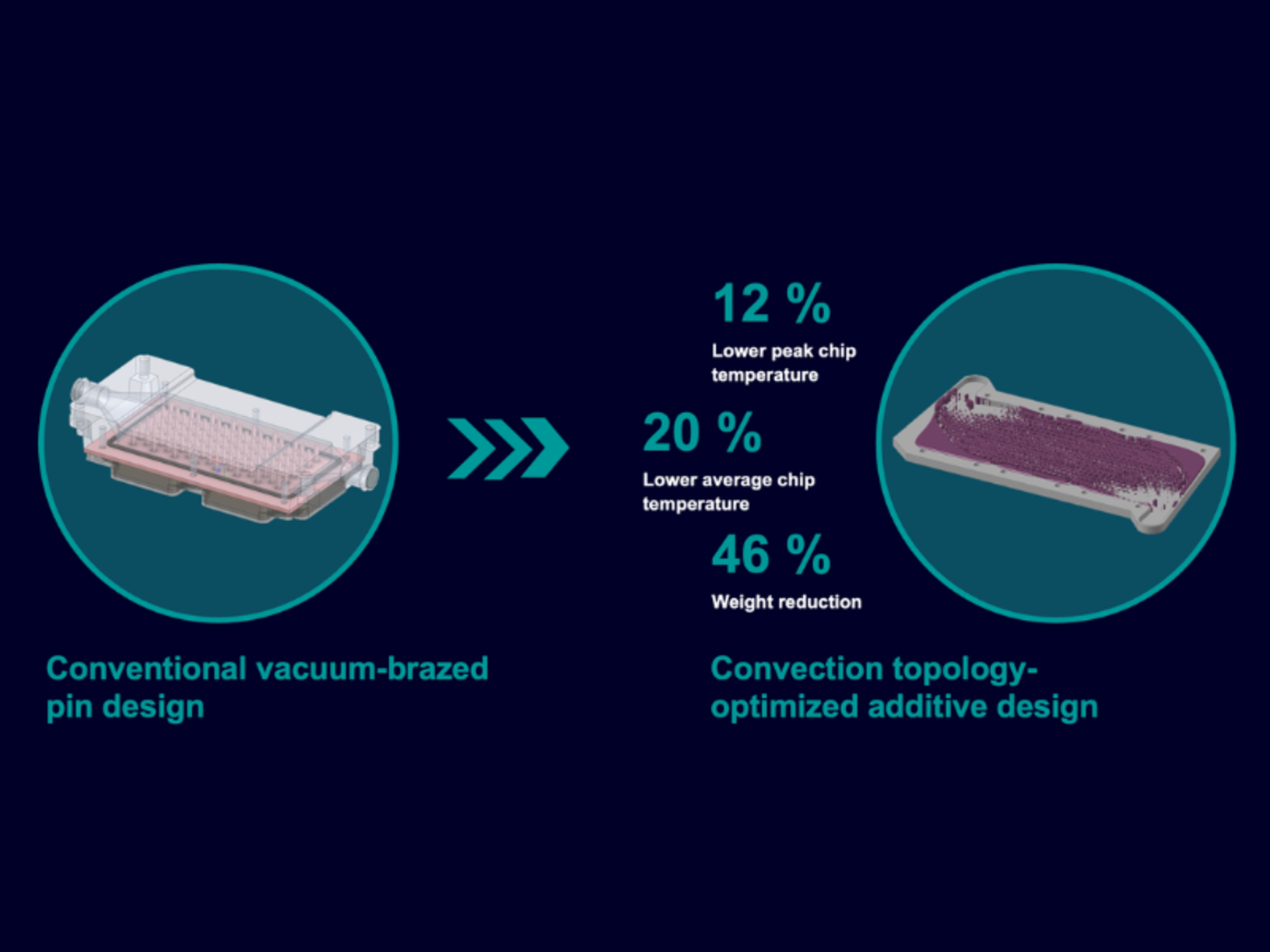
Compared to conventional vacuum-brazed pin designs, the additively manufactured liquid cold plates deliver clear performance improvements:
- Up to 12% lower peak chip temperature
- Up to 20% lower average chip temperature
- Up to 46% weight reduction
- Improved temperature homogeneity
- Reduced leakage risk due to monolithic designs
- Scalability to production volumes exceeding 100,000 cold plates per year
Different additive design concepts allow targeted optimization, whether prioritizing maximum heat transfer, minimal pressure drop, or reduced component weight.
Conclusion
This case study demonstrates how a comprehensive digital thread combined with industrial metal additive manufacturing enables high-performance, reliable, and scalable liquid cold plate cooling for electronics. By leveraging Siemens’ digital engineering capabilities and EOS metal AM technology, and through close collaboration with GKN Additive, additive manufacturing becomes a production-ready solution for next-generation high-performance electronic systems.
About the Companies
Siemens Digital Industries (DI)
Siemens DI empowers companies of all sizes within the process and discrete manufacturing industries to accelerate their digital and sustainability transformation across the entire value chain. Siemens’ cutting-edge automation and software portfolio revolutionizes the design, realization and optimization of products and production. And with Siemens Xcelerator – the open digital business platform – this process is made even easier, faster, and scalable. Together with our partners and ecosystem, Siemens Digital Industries enables customers to become a sustainable Digital Enterprise. Siemens Digital Industries has a workforce of around 70,000 people worldwide.
Siemens AG (Berlin & Munich)
Siemens AG is a leading technology company focused on industry, infrastructure, mobility, and healthcare. The company’s purpose is to create technology to transform the everyday, for everyone. By combining the real and the digital worlds, Siemens empowers customers to accelerate their digital and sustainability transformations, making factories more efficient, cities more livable, and transportation more sustainable. A leader in industrial AI, Siemens leverages its deep domain know-how to apply AI – including generative AI – to real-world applications, making AI accessible and impactful for customers across diverse industries. Siemens also owns a majority stake in the publicly listed company Siemens Healthineers, a leading global medical technology provider pioneering breakthroughs in healthcare. For everyone. Everywhere. Sustainably. In fiscal 2025, which ended on September 30, 2025, the Siemens Group generated revenue of €78.9 billion and net income of €10.4 billion. As of September 30, 2025, the company employed around 318,000 people worldwide on the basis of continuing operations. Further information is available on the Internet at www.siemens.com
GKN Additive
GKN Powder Metallurgy is a market leader in high precision metal components and a leading manufacturer of advanced powder metallurgy materials. The company provides innovative product solutions and technologies, including state of the art additive manufacturing processes with GKN Additive. It is the only company with vertical integration from powder production to part production. Together with its customers, the business solves complex challenges in the automotive and industrial sectors through advanced powder metal based technology solutions. GKN Powder Metallurgy is part of Dauch. Dauch Corporation (formerly American Axle & Manufacturing) acquired GKN Powder Metallurgy in February 2026. Both companies now operate under the united corporate brand Dauch. For more information, visit www.dauch.com


