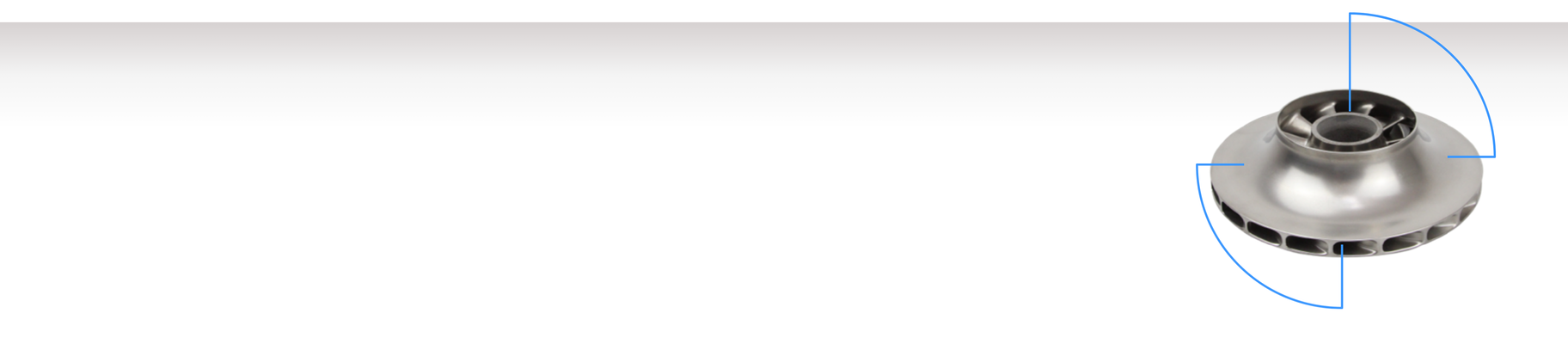
Titanium Casting vs. ColdMetalFusion
Which Manufacturing Method Wins for Pumps & Valves?
10 FEBRUARY, 2026 | Reading time: 8 min
Titanium is an outstanding material for pumps and valves: corrosion‑resistant, lightweight, biocompatible, and extremely durable in challenging chemical, hygienic, and high‑pressure environments. But choosing how to manufacture titanium parts has become just as important as choosing the material itself.
For decades, titanium casting and forging dominated industrial production. Today, ColdMetalFusion (CMF) - a sinter‑based metal AM process used on the FORMIGA P 110 CMF - is quickly emerging as a powerful, scalable titanium casting alternative.
So how do these two manufacturing routes compare?
Which delivers better performance, cost, and design freedom?
And when should engineers switch from casting to CMF?
Let’s break it down.
The Challenge With Titanium Casting
Titanium casting is notoriously difficult. Titanium reacts readily with oxygen at high temperatures, which forces foundries to use specialized molds, controlled atmospheres, and advanced melting techniques. This adds significant cost and limits design freedom.
Key limitations of titanium casting:
- Complex geometries are difficult or impossible
Casting struggles with thin walls, tight radii, undercuts, internal flow channels, or sharp transitions. Features common in pumps—like twisted impeller blades or internal diffusers—often require redesigns or multi‑part assemblies. - Tooling cost is high and inflexible
Every variant or custom geometry requires new tooling. For OEMs producing many pump configurations, this quickly becomes a cost and lead‑time bottleneck. - Dimensional variations are common
Chill zones, shrinkage, and mold inconsistencies introduce variability. Finishing and machining steps often must compensate. - Lead times are long
Pattern making, mold setup, casting, HIP, heat treatment, machining, and inspection cycles can extend for weeks or months. - Shrinkage cavities
These internal voids, caused by uneven solidification, are a common defect that weakens structural integrity, reduces fatigue performance, and increases inspection and rework effort.
Casting remains viable for very high volumes of simple parts—but its limitations show quickly in engineered titanium components.
What Is ColdMetalFusion (CMF)?
ColdMetalFusion is a sinter‑based metal additive manufacturing (AM) process that combines polymer laser sintering with powder metallurgy. Using a polymer‑metal feedstock, the FORMIGA P 110 CMF prints near‑net‑shape titanium green parts at low temperatures (30–50 °C), which are then debound and sintered to to achieve Ti-6Al-4V properties comparable to traditional sinter-based manufacturing processes like MIM (Metal Injection Molding).
Why engineers consider CMF a true titanium casting alternative:
- Design freedom comparable to laser powder bed fusion but at lower cost
- 100% feedstock reusability
- Low CAPEX, leveraging a polymer SLS platform
- Support‑free printing, ideal for impellers and diffusers
- Material properties suitable for demanding pump & valve applications
- Scalable for low‑ to mid‑volume production
CMF keeps the economics attractive while drastically expanding geometric possibilities.
Casting vs. CMF: Side‑by‑Side Comparison
|
Category
|
Titanium Casting
|
ColdMetalFusion (CMF)
|
|---|---|---|
|
Design Freedom
|
Limited: thin walls, internal features, and complex curves are difficult or impossible
|
Excellent: internal channels, curved blades, diffusers, and complex flow geometries
|
|
Lead Time
|
Weeks to months
|
Days to weeks
|
|
Tooling Required
|
Yes, expensive and inflexible
|
None
|
|
Geometric Accuracy
|
Moderate: dependent on molds and cooling
|
High: consistent powder‑based process
|
|
Surface Finish
|
Consistent
|
Consistent: finishing similar to casting
|
|
Material Properties
|
Solid, but often requires HIP and machining
|
Near‑MIM titanium properties after sintering
|
|
Volume Suitability
|
High volumes
|
Low‑ to mid‑volumes, variant‑rich production
|
|
Cost Efficiency
|
Good only at scale: tooling dominates low‑volume cost
|
Strong for series production without tooling
|
|
Sustainability
|
Scrap and gating losses
|
100% feedstock reusability
|
Where CMF Outperforms Titanium Casting
- Complex Pump Impellers
CMF can print impellers flat and support‑free, enabling high throughput and efficient builds. Casting cannot achieve the same internal curvature or thin‑blade geometries without segmented tooling—if at all. - Diffusers & Flow Components
Internal channels, tapered inlets, and free‑form flow designs unlock efficiency improvements not achievable with casting - Variant‑Rich Product Portfolios
Pumps and valves often exist in dozens or hundreds of configurations. CMF eliminates tooling, enabling cost‑efficient customization. -
Faster Prototyping & Iteration
Engineers can move from design to sintered titanium parts in **days**, not months. This accelerates testing and drastically reduces development cycles.
When Casting Still Has Advantages
Casting is still relevant when:
- Volumes are extremely high
- Designs are simple and stable over years
- Lead times are less critical
- Tooling investment is justified
But even in these cases, CMF can complement casting by supporting:
- Pre‑tooling pilot runs
- Customized product variants
- Low‑volume replacements or service parts
Many manufacturers end up integrating both processes strategically.
The Bottom Line: Is CMF the Better Titanium Casting Alternative?
For the majority of titanium pump and valve components - especially impellers, diffusers, housings, and engineered flow parts - CMF delivers better agility, better geometric capability, and competitive per‑part economics.
Manufacturers choose CMF when they need:
- Geometry impossible to cast
- Lower cost at mid‑volumes
- Tooling‑free production
- Faster iteration cycles
- Consistent dimensional accuracy
- Proven Ti‑6Al‑4V performance
In these cases, CMF is not just an option—it is the preferred titanium casting alternative.
Ready to Evaluate CMF for Your Titanium Parts?
If you manufacture pump or valve components and want to reduce tooling cost, improve performance, or unlock new designs, CMF on the FORMIGA P 110 CMF may be the right fit.

